Empowering Engineering Excellence: Innovate, Elevate, Deliver.

10 Best Hydraulic Jacks for Heavy Duty Use

Heavy-duty lifting demands more than a high capacity rating. A Hydraulic Jack must suit the vehicle, the work surface, and the available clearance. A pickup truck, delivery van, and loaded trailer can each require different lift heights and support points. Choosing by tonnage alone can leave a jack too low, too large, or difficult to position.

This guide compares ten hydraulic jacks for demanding garage and roadside tasks. It considers rated capacity, minimum and maximum lift height, construction, stability, and ease of use. Those details matter when a low-profile floor jack must slide beneath a vehicle, or a bottle jack needs a firm, level base. Pump effort and release control also deserve attention. Small design differences can change how confidently a load rises and lowers.

No single model fits every job. A heavy jack may feel reassuring, yet its weight can make storage and transport awkward. A compact option may be convenient, but its lift range might not suit taller vehicles. Specifications should be checked against the vehicle manufacturer’s lifting points and the jack’s stated limits. Use jack stands for support; never rely on a hydraulic jack alone. That step is easy to overlook. The selections ahead are intended to help readers compare practical trade-offs, not replace careful setup or the product manual. Even a well-reviewed tool needs the right surface, placement, and maintenance. Pulling together those details can take time, and the best choice is not always the most powerful one.
10 Best Hydraulic Jacks for Heavy Duty Use

How Heavy-Duty Hydraulic Jacks Work and Where They Are Used

A heavy-duty hydraulic jack turns a small pumping effort into substantial lifting force. Its handle drives a pump that pushes hydraulic fluid into a cylinder. Pressure moves a piston upward, raising the saddle and its load. The principle is simple, but the jack’s capacity depends on its design, condition, and setup. Slow, controlled lifting matters.

These jacks are used beneath trucks, buses, industrial machinery, and farm equipment. A bottle jack fits into a compact space, while a floor jack rolls beneath a vehicle. In a workshop, a mechanic may lift one corner to inspect a wheel or suspension. On a job site, crews may raise heavy equipment for positioning. Each task needs a jack rated for the load and suited to the available clearance.

The ground must be firm and level. A jack can tilt on soft gravel, even when it feels stable at first. Check for leaks, damaged hoses, and a slipping saddle before use. Never work beneath a raised load supported only by a jack; secure it with properly rated stands. That extra step can feel slow. It is still essential. Hydraulic equipment also needs maintenance, and a worn seal may cause gradual lowering—something easy to miss in a noisy shop.
Key Features to Compare When Choosing a Heavy-Duty Hydraulic Jack

Choosing a heavy-duty hydraulic jack starts with its rated capacity, but capacity alone is not enough. Compare the rating with the load at the lifting point, and leave a sensible margin. Check the minimum and maximum lift heights against your vehicle’s clearance and service needs. A jack that cannot slide beneath a low chassis is no help, even if its rating looks impressive. Small details matter.

Inspect the saddle size, frame width, and wheel design. A broad saddle can make contact more secure, while sturdy wheels help position a heavy jack on a firm, level floor. Look for controlled lowering and a handle that allows smooth pumping without awkward body strain. Hydraulic systems can leak or lose performance over time, so accessible seals and clear maintenance guidance are practical advantages. It is easy to focus on lifting speed and overlook stability.

Tips: Check the jack’s manual and lifting points before use. Never rely on a hydraulic jack alone to hold a raised load; use appropriately rated support stands on stable ground. Keep hands clear while lowering. A quick visual check helps, though it does not replace proper inspection.

Ten Hydraulic Jacks Compared by Capacity, Design, and Best Use

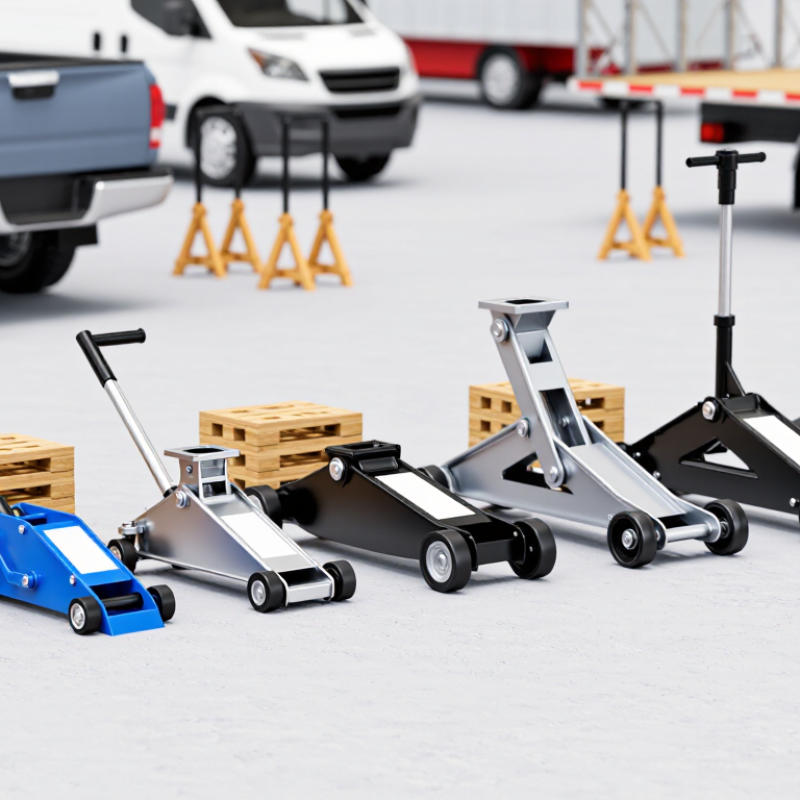
A compact bottle jack suits a small work area, while a high-capacity bottle jack handles heavier loads with a narrow footprint. Both need firm, level ground. A low-profile trolley jack slides beneath cars with limited clearance; a standard trolley jack trades some reach for everyday workshop use. Long-reach floor jacks suit vehicles with distant lifting points. Aluminum floor jacks are easier to move, though their lighter build may feel less substantial. Feel matters.

A transmission jack supports gearboxes with a broad, adjustable saddle. A toe jack can lift machinery where overhead clearance is tight. An air-over-hydraulic bottle jack speeds repeated lifting when compressed air is available. A high-lift bottle jack offers extra travel, but its taller setup needs careful positioning. Compare rated capacity, minimum height, lift range, base width, and saddle shape—not capacity alone. A jack that fits beneath a vehicle may still miss its approved lifting point. That detail is easy to overlook. In practice, uneven concrete, a slipping handle, or a poorly placed saddle can change the job. Use a jack only for lifting, and support the load with properly rated stands before working beneath it.

10 Best Hydraulic Jacks for Heavy-Duty Use

Representative rated capacities for common hydraulic jack designs. Actual capacities vary by model; always follow the manufacturer’s rating and use suitable supports.

Capacity is only one selection factor: floor jacks suit vehicle service, bottle and telescopic jacks provide compact lifting, toe jacks work beneath low-clearance loads, and industrial cylinder or air-hydraulic jacks serve high-capacity applications.

Jack design Representative capacity Typical best use
Compact floor jack2 tonsPassenger vehicles and lighter service work
Heavy-duty floor jack3 tonsCars, SUVs, and light trucks
Bottle jack20 tonsCompact lifting of trucks and equipment
Low-profile bottle jack12 tonsLoads with limited ground clearance
Telescopic bottle jack50 tonsHeavy loads needing greater lifting height
Long ram jack10 tonsShop presses, hoists, and fabrication equipment
Toe jack10 tonsMachinery with little clearance beneath the base
Air-hydraulic jack50 tonsFrequent heavy lifting where compressed air is available
Railroad hydraulic jack50 tonsTrack maintenance and other demanding field work
Industrial hydraulic cylinder jack100 tonsHeavy industrial lifting with a compatible pump

How to Choose the Right Jack for Your Vehicle and Workload

Choosing a hydraulic jack starts with your vehicle’s weight, approved lift points, and working height. Check the manual for lift-point locations, then compare the jack’s rated capacity and lifting range with the job. A low-profile model may fit beneath a sports car, while a taller truck may need extra reach. Capacity matters, but it is not the whole story.

Think about where you will use it. A wide, stable base is useful on a firm, level floor; soft gravel can make even a heavy jack shift. Check that the saddle fits the vehicle’s lift point, and that the handle has room to move. Small details matter. A few centimeters can decide whether the jack fits under the chassis.

Look for controlled lowering, a readable release mechanism, and visible signs of leaks or damage. Never work beneath a vehicle supported only by a jack; use properly rated stands at the specified support points, and secure the wheels that remain on the ground. A higher-capacity jack may feel reassuring, but it can also be heavier and awkward to position. I would not choose by tonnage alone. Recheck the jack before each use, especially if it has been stored in a damp garage.

Safe Operation, Inspection, and Maintenance of Hydraulic Jacks

A heavy-duty hydraulic jack is only as safe as its setup. Park on firm, level ground, engage the parking brake, and chock the wheels that remain on the ground. Check the jack’s rated capacity against the load; vehicle weight alone may not show how much weight one lifting point carries. Place the saddle squarely on the approved lifting point. Small defects matter.

Raise the load smoothly, watching for saddle movement or a tilted jack. Stop if the handle suddenly feels different, the vehicle shifts, or fluid appears around the cylinder. A jack lifts; it does not secure. Once raised, support the vehicle with correctly rated stands on suitable points, then confirm it rests steadily before working nearby. Never rely on hydraulic pressure alone.

Inspect the frame, wheels, saddle, handle, and hose before use. Look for bent metal, cracked welds, loose parts, leaks, or a saddle that no longer sits flat. Keep the jack clean, and check hydraulic fluid or bleed trapped air only as its instructions specify. Don’t top it up with an arbitrary fluid. Store it lowered and dry. It is tempting to skip checks when a lift seems routine, but that shortcut is hard to defend after a failure. Recheck after any unusual load or impact.

10 Best Hydraulic Jacks for Heavy Duty Use - Safe Operation, Inspection, and Maintenance of Hydraulic Jacks

A practical comparison of common heavy-duty hydraulic jack types, their typical applications, and essential safety checks.

Rank Jack Type Typical Rated Capacity Typical Lift Range Best Suited For Key Inspection Points Safe Use and Maintenance
1 Heavy-duty bottle jack 10–20 tons Approximately 7–18 in (180–460 mm), depending on model Trucks, trailers, machinery, and other loads with a suitable lifting point Check the ram, saddle, base, release valve, and hydraulic seals for damage or leakage. Place on firm, level ground and center the load on the saddle. Use rated jack stands before working beneath a raised load.
2 Low-profile floor jack 2–3 tons Approximately 3–20 in (75–510 mm) Passenger vehicles with limited ground clearance Inspect wheels, lifting arm, saddle, handle socket, and hydraulic system; confirm the jack rolls freely. Use only at the vehicle’s approved lifting points. Chock the wheels and support the vehicle with correctly rated stands.
3 High-lift floor jack 3–4 tons Approximately 5–24 in (125–610 mm) Heavy vehicles, workshop servicing, and vehicles requiring extra lifting height Check the frame, wheels, pivot points, saddle, and for oil seepage or uneven lifting. Keep the jack on a hard, level surface and avoid side loading. Do not rely on hydraulic pressure alone to hold a load.
4 Air-hydraulic bottle jack 20–50 tons Approximately 9–20 in (230–510 mm) Commercial vehicle service, fleet workshops, and heavy equipment maintenance Inspect hydraulic components, air hose and fittings, controls, base, and saddle before each use. Connect only to the air pressure specified by the jack manufacturer. Keep hands clear of pinch points and use mechanical supports.
5 Hydraulic transmission jack 0.5–1 ton Approximately 34–72 in (860–1,830 mm) Removing and installing vehicle transmissions and other balanced components Check the saddle restraints, chains or straps, tilt controls, casters, and hydraulic seals. Secure the component to the saddle and keep it balanced. Do not move the jack with an unsecured or raised load.
6 Hydraulic toe jack 5–10 tons Toe lift typically begins near 1 in (25 mm); total travel varies by model Lifting machinery with low ground clearance for positioning or installation Inspect the toe, heel, ram, base, and contact surfaces for cracks, deformation, or hydraulic leaks. Ensure the toe is fully engaged at a manufacturer-approved lifting point. Keep the load stable and use blocking as it is raised.
7 Long-ram hydraulic jack 5–10 tons Approximately 20–48 in (510–1,220 mm) Equipment positioning, presses, and applications needing longer ram travel Check the ram for scoring or bending and inspect the mounting, pivot points, hose, and seals. Mount securely as specified and apply force in line with the ram. Never exceed the rated load or use the ram as a permanent support.
8 Portable hydraulic floor jack 1.5–2 tons Approximately 5–18 in (125–460 mm) Light commercial vehicles, mobile service work, and general workshop lifting Inspect the handle, wheels, saddle, frame, and hydraulic system; confirm the release mechanism works smoothly. Position the jack centrally beneath an approved lifting point. Raise slowly and transfer the load to rated stands.
9 Heavy-duty bottle jack with extension screw 20–30 tons Approximately 9–19 in (230–480 mm), including model-dependent screw extension Construction equipment, loaded trailers, and heavy machinery with high lifting points Check the extension screw, saddle, base, ram, and seals; verify that the screw is not damaged or overextended. Use only the permitted extension and keep the jack vertical on a suitable base. Never place hands or body beneath an unsupported load.
10 Hydraulic toe jack with integrated pump 10–20 tons Toe lift commonly starts around 1–2 in (25–50 mm); travel varies by model Industrial machinery installation and lifting heavy loads from a low starting height Inspect the toe, pump controls, return mechanism, base, and hydraulic connections for wear or leakage. Use on a firm, level surface and lift evenly. Secure the load with suitable cribbing or mechanical supports before positioning work.

Important: Capacity and lift ranges shown are typical examples, not specifications for a particular jack. Always follow the jack manufacturer’s instructions, verify the rated capacity and lifting points, inspect the equipment before use, and support raised loads with appropriately rated mechanical stands. Never work beneath a load supported only by a hydraulic jack.

Download
Brochure