Empowering Engineering Excellence: Innovate, Elevate, Deliver.
What Are wine filter sheets and How Do They Work?
Wine filter sheets are porous filtration materials used to clarify wine before bottling. They help remove yeast, suspended particles, and some microorganisms. Their structure resembles a dense, layered paper. However, these sheets are engineered for controlled flow and particle retention.
During filtration, wine passes through microscopic channels under pressure. Larger particles become trapped on the sheet surface. Smaller particles may remain inside the sheet’s depth. The result can be a brighter appearance and improved microbiological stability.
Dr. Bruce Zoecklein, a respected wine chemistry educator, offered a practical principle: “Filtration should preserve wine quality, not merely improve its appearance.”
That idea matters. A brilliant-looking wine can still feel flat if filtration is too aggressive. Sheet selection depends on the wine’s clarity, viscosity, microbial risk, and intended shelf life. Cellar teams usually begin with coarse sheets. They may then use tighter grades for final polishing or sterile bottling.
The process is not completely mechanical. Operators must monitor pressure, flow rate, temperature, and sheet integrity. A sudden pressure increase may signal clogging. It can also reveal poor pre-clarification.
Small details matter. A clean housing, sanitized connections, and properly wetted sheets reduce contamination risks. Yet filtration is not a cure-all. It cannot repair oxidation, harsh tannins, or flawed aromas.
There is room for judgment. Some winemakers accept slight haze to retain texture and character. Others prefer a highly polished, stable presentation. Understanding wine filter sheets helps producers make that choice more deliberately, rather than treating clarity as the only measure of quality.
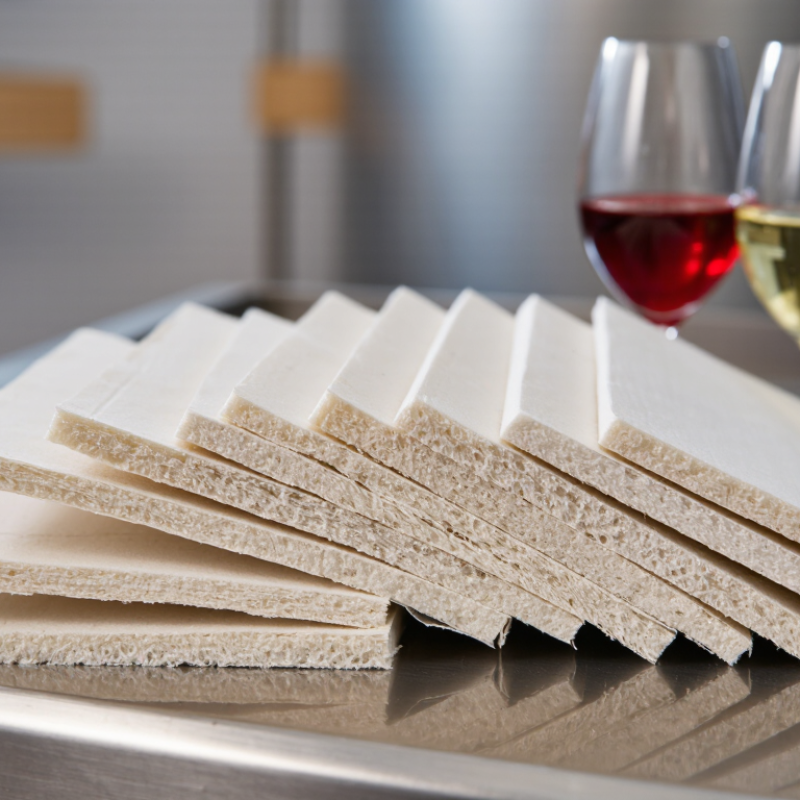
Wine filter sheets are flat, porous pads used to clarify wine before bottling. They usually contain cellulose fibers, sometimes combined with mineral filter materials. Their structure traps suspended particles as wine passes through. These particles may include yeast, grape residue, protein haze, or other fine sediment.
The sheets are fitted inside a plate filter or similar filtration housing. Wine moves through under controlled pressure. Coarse sheets remove visible particles, while finer sheets capture smaller organisms and haze-forming material.
The correct grade depends on the wine’s condition and the desired clarity. A clean, bright wine may need only gentle filtration. A cloudy wine may require more than one stage.
Wine filter sheets are used to improve appearance, reduce sediment, and support a stable bottling process. They can help prevent new deposits from forming in the bottle. However, filtration does not repair every flaw. It cannot replace sound sanitation, careful storage, or laboratory checks. Sterile filtration also requires suitable equipment and validated procedures; a filter sheet alone should not be treated as a guarantee.
The practical mistake is choosing a very fine sheet too quickly. Fine filtration can slow the flow and may reduce aroma or body when handled poorly. Wine composition, temperature, pressure, and sheet condition all matter. Even experienced producers sometimes need to adjust their method. Small trials are wiser than assumptions.
Wine filter sheets are porous, flat media used to clarify wine before bottling. Their design combines a supporting fiber network with microscopic channels. As wine passes through, suspended yeast, protein haze, and other particles become trapped inside the sheet, not merely on its surface.
Most sheets use purified cellulose fibers. Some grades add diatomaceous earth or perlite to create deeper, more irregular pathways. Small amounts of approved binding material can improve strength and wet handling. The sheet’s thickness, density, and pore rating control retention. A coarse sheet may remove larger particles, while a tighter grade targets finer haze. Cellulose feels paper-like, but its internal structure is engineered. That difference matters.
During use, operators normally wet the sheets, check for channeling, and monitor pressure rise. A sudden pressure increase often signals loading or poor alignment. According to the OIV’s 2024 wine sector report, global wine production reached about 237 million hectoliters in 2023. FAOSTAT data also places global grape production above 75 million tonnes in 2022. Such scale makes repeatable filtration valuable, even when a small cellar works manually. Yet pore ratings are not universal performance guarantees. Wine composition, temperature, and prefiltration change results. I have found that a visually bright sample can still need laboratory testing. That is the uncomfortable part: clear wine does not always mean stable wine.
Wine filter sheets are flat, porous materials placed inside a filter housing. They are commonly made from cellulose fibers, sometimes combined with mineral filtration aids. Their main job is to remove suspended particles before bottling or further storage. These particles may include yeast cells, grape pulp, protein haze, and small sediment fragments.
The process uses pressure to push wine through the sheet. Larger particles become trapped on the surface, while smaller particles travel into the sheet’s deeper fiber structure. This is called depth filtration. A tighter sheet can produce clearer wine, but it may also slow the flow and increase pressure. Filtration is not a magic reset. Very cloudy wine can block a fine sheet quickly, so producers often use a coarser sheet first.
Sheet selection depends on the wine’s condition and the desired clarity. A trained operator checks the wine, monitors pressure, and replaces the sheet when flow becomes unstable. Clean equipment matters, too. Even a highly efficient sheet cannot correct contamination introduced by a poorly sanitized housing. Some wines may lose a small amount of color, aroma, or texture during aggressive filtration. That trade-off deserves careful thought. In practice, clarity is useful, but it should not automatically outweigh the wine’s character. Salt-like tartrate crystals also need special attention, because filtration alone may not prevent them from forming later.
Sheet filtration usually begins after settling, racking, or centrifugation. The wine first passes through a coarse sheet that traps larger particles, yeast clusters, and some colloids. This protects finer sheets from rapid blockage. It is not glamorous, but it prevents many avoidable problems.
The next stage uses tighter sheets for polishing. Cellulose fibers create a maze, while filter aids can improve particle retention. Flow pressure, wine temperature, and turbidity must be watched closely. A sudden pressure rise often signals fouling, not better clarification. The OIV Code of Oenological Practices recognizes filtration as a standard clarification technique. Its guidance also stresses suitable materials and controlled operation.
Final filtration may use very fine sheets, depending on the wine’s stability target. However, sheet filtration should not automatically be called sterile filtration. A 0.45-micrometre membrane is commonly selected for microbial reduction, but performance depends on validation, pressure, and product condition. The Australian Wine Research Institute repeatedly highlights these control points in its technical guidance. The OIV’s 2023 sector report estimated global wine production at about 237 million hectolitres, showing why repeatable filtration matters across large volumes. Small errors scale quickly. Even experienced teams sometimes over-filter, stripping texture while chasing visual brilliance. Sensory checks should remain part of the decision.
What Are Wine Filter Sheets and How Do They Work?
Wine filter sheets are porous pads made from cellulose, cotton, or blended fibers. They remove suspended yeast, particles, and haze as wine passes through microscopic channels. Some sheets mainly trap particles on the surface, while depth sheets hold particles inside the fiber structure. Their performance depends on pore size, pressure, wine viscosity, and pre-filtration quality.
How to Choose the Right Wine Filter Sheet for Each Application
Choose the sheet by the wine’s condition and the required clarity. Coarser sheets suit rough filtration after pressing or tank transfer. Finer sheets work better for polishing before bottling. A very fine sheet can clog quickly when the wine still contains heavy sediment. Do not guess.
In practice, check the supplier’s micron rating, flow range, material compatibility, and maximum pressure. A sheet should fit the filter housing without gaps or edge bypass. Rinse or wet it as instructed, then inspect the first filtered wine for unusual odor, color loss, or excessive foam. Pressure tells a story. A rapid pressure increase often signals poor pre-filtration or an unsuitable sheet. Lower micron ratings are not automatically better; they may reduce flow and waste more wine. I have found that small trials with one or two sheets reveal more than relying on specifications alone. Keep records of wine variety, temperature, flow rate, and pressure, because the same sheet may behave differently across batches.
Wine filter sheets are porous depth-filter media that retain suspended particles as wine passes through interconnected channels. The appropriate rating depends on the required clarity, microbial-risk reduction, flow rate, and wine characteristics.
How to choose: Coarser sheets are commonly selected for clarification and higher flow, while finer filtration is used for polishing and final microbial-risk reduction. A lower micron rating provides finer retention but can reduce throughput and may require more frequent replacement.