Empowering Engineering Excellence: Innovate, Elevate, Deliver.

Why Choose a Range Exhaust Hood for Your Kitchen?

A kitchen can look spotless while cooking emissions linger in the air. Steam rises from a pot, oil spatters across a hot pan, and fine particles spread beyond the stove. A Range Exhaust Hood helps capture smoke, odors, moisture, and combustion pollutants near their source. But performance is not automatic. Hood shape, installation height, fan speed, and whether air vents outdoors all matter.

Research from Lawrence Berkeley National Laboratory, including work by Singer and colleagues published in Building and Environment, shows that cooking exhaust devices vary widely in their ability to capture emissions. A powerful fan alone does not guarantee effective capture; the hood must cover the cooking area and draw air properly. Indoor-air researcher Brett Singer’s practical guidance is: “Use a range hood whenever you cook, and make sure it vents outdoors.” That small habit can make a difference. Still, a hood is not a substitute for sensible ventilation or regular cleaning.

Choosing one means weighing more than appearance. Consider capture coverage, airflow, noise, filter access, and duct routing before comparing finishes or controls. Picture a wide skillet sending a ribbon of smoke toward the cabinets. A well-matched hood can catch much of it before it spreads. A poorly placed one may leave the room smelling of dinner long after the plates are cleared. The details matter. And they deserve a closer look.
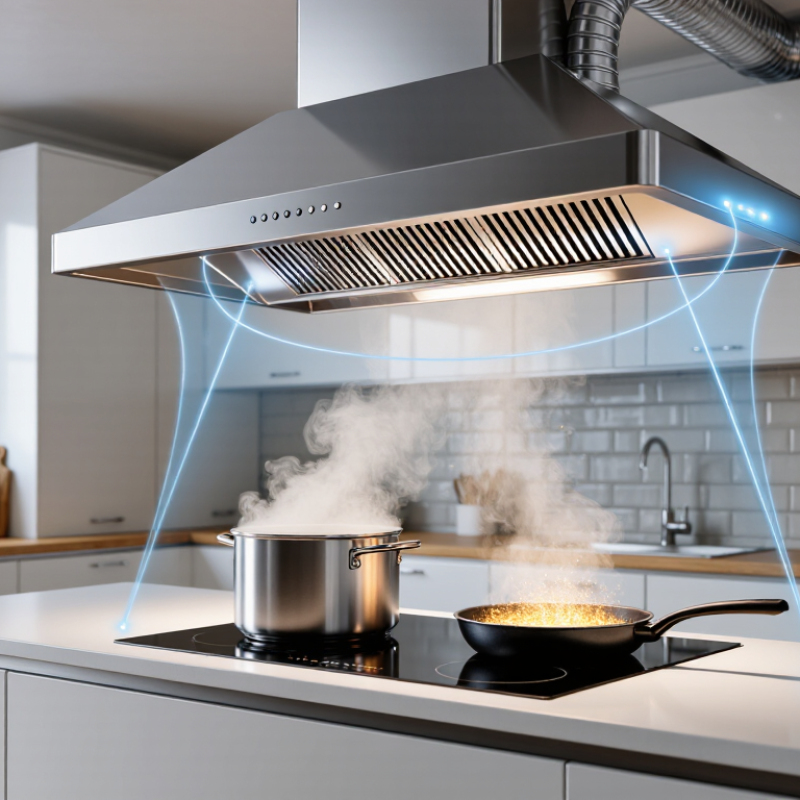
Why Choose a Range Exhaust Hood for Your Kitchen?

Range Hood Basics: Capture Cooking Smoke and Grease at the Source

A range hood works best when it catches smoke and grease before they spread across the kitchen. Positioning matters: the hood should cover the cooking area and follow the recommended installation height. A narrow or overly high hood can miss rising plumes, especially from a front burner. Smoke moves quickly.

Turn the hood on before oil begins to shimmer or food starts to brown. This gives airflow time to pull emissions toward the filters before they drift to cabinets and walls. Choose a setting that clears the plume without making conversation difficult. After cooking, let it run briefly to remove lingering vapor. Not magic.

Grease filters collect particles, but they need regular cleaning. A sticky filter can restrict airflow. Wash reusable filters as directed, and check that the exhaust path is clear. Ducted systems send air outdoors; recirculating models filter it and return it to the room. Their performance differs. No hood removes every odor or particle. Choose one suited to your range and cooking habits, then check whether it captures emissions where they begin.

Airflow Sizing: HVI Guidelines Suggest 100 CFM per Wall-Hood Foot

A range hood is only useful when it captures cooking pollutants before they spread. For a wall-mounted hood, Home Ventilating Institute (HVI) sizing guidance commonly suggests about 100 cubic feet per minute (CFM) per linear foot of hood width. A 30-inch hood is 2.5 feet wide, so this rule points to roughly 250 CFM. That is a starting point, not a guarantee.

Real kitchens complicate the math. A deep hood with broad coverage may capture steam better than a shallow unit at the same rated airflow. Long or narrow ducts, tight elbows, and dirty filters can also reduce delivered airflow. Check the manufacturer’s tested performance and duct requirements; HVI’s certified ratings help compare products under consistent test conditions. ASHRAE Standard 62.2-2022 lists 100 CFM for intermittent kitchen exhaust, a separate baseline that does not replace hood sizing for a particular cooking setup. Boiling pasta is forgiving. Searing fish is not. I would leave some capacity in reserve, though oversizing without suitable ductwork can add noise and disappoint.

Why Choose a Range Exhaust Hood for Your Kitchen?

As a general sizing guideline, HVI suggests 100 CFM for each linear foot of a wall-mounted hood. The chart applies that guideline to common hood widths; for example, a 36-inch hood corresponds to 300 CFM. Check your cooktop requirements and local building codes when selecting a hood.

Code Check: IRC Sets 100 CFM Intermittent or 25 CFM Continuous

A range hood is more than a light over the cooktop. It captures smoke, grease, and moisture near their source, before they spread across cabinets or settle on a nearby window. The IRC benchmark in the subtitle is a useful starting point: 100 CFM for intermittent operation or 25 CFM for continuous operation. CFM measures airflow in cubic feet per minute. That matters.

These figures describe different operating patterns, not two settings that work equally well in every kitchen. An intermittent hood runs when cooking; a continuous system runs at a lower rate over time. The right choice depends on the appliance, cooking habits, hood placement, and duct route. A long or restrictive duct can reduce airflow, even when the fan’s rating looks adequate on paper. Quiet operation is helpful, but weak capture is not.

Check the locally adopted code edition and ask the building department or a qualified installer about applicable requirements. Local amendments may differ, and installation details matter. The hood should exhaust outdoors through an approved duct, not simply recirculate air, where the code requires an exhaust system. Also confirm whether added ventilation or makeup air provisions apply to your project. The numbers are a baseline, not a guarantee of good performance. A quick check before buying can prevent a noisy hood that still leaves a haze above the stove.

Ducting Matters: Vent Range Hoods Outdoors for Effective Exhaust

Why Choose a Range Exhaust Hood for Your Kitchen?

A range hood works best when it moves cooking fumes outdoors through a properly planned duct. Without an exterior route, a recirculating hood may reduce some odors, but it cannot remove heat and moisture from the room in the same way. That difference becomes clear when a pot simmers and the kitchen windows begin to fog.

Choose ductwork that matches the hood’s outlet size, and keep its path as short and straight as practical. Sharp bends and undersized ducts can restrict airflow and make the fan louder. Smooth metal ducting is generally easier to clean than flexible, ribbed ducting. Not every kitchen allows an ideal route. If the duct must cross cabinets or an exterior wall, have a qualified installer check the plan and follow the hood’s installation instructions.

Tips: Run the hood before cooking, then leave it on briefly afterward. Clean its filters regularly, and check that the outdoor vent flap opens freely. Small details count. A hood can look powerful on paper, yet still disappoint if the duct is poorly planned.

Compare Performance: Check HVI-Certified Airflow, Sound, and Energy Ratings

When comparing a range hood, look beyond its maximum airflow claim. Check the Home Ventilating Institute (HVI) directory for certified airflow and sound ratings. HVI uses standardized test methods, including HVI 916 for airflow and HVI 915 for sound. Compare models at similar airflow settings; a quiet low-speed rating may not describe dinner-time performance. One sone is quiet. Still, kitchen noise depends on installation and ductwork, too.

Capture matters as much as airflow. A 2012 Lawrence Berkeley National Laboratory field study, “Performance of Installed Cooking Exhaust Devices,” found capture efficiency ranging from 15% to 98% among tested devices. That wide spread is a useful caution: a high CFM number alone cannot show how well fumes are captured above your burners. For energy use, compare watts at the setting you expect to use, and calculate airflow per watt when those figures are available. More airflow can mean more power and noise. The trade-off is real. I would check duct size and route before trusting a rating to predict results; that step is easy to overlook.

Download
Brochure