Empowering Engineering Excellence: Innovate, Elevate, Deliver.
custom cellophane self adhesive labels combine a clear, thin film with a pressure-sensitive adhesive. The film is commonly made from regenerated cellulose. It lets the product remain visible while printed text, color, and logos sit directly on the label. Peel away the backing, then press the label onto a clean surface. No separate glue is needed.
These labels can suit jars, bottles, gift boxes, and small-batch products where a discreet finish matters. A transparent label can appear almost printed on glass, though the effect depends on the artwork, surface, and lighting. Label consultant Mike Fairley has described labels as a “silent salesperson,” capturing their role in attracting attention and conveying product information. The phrase is memorable, but a label still needs to be readable and accurate.
The market context is substantial. Grand View Research’s Pressure Sensitive Labels Market Size, Share & Trends Analysis Report estimates the global market at about US$45 billion in 2023. That figure covers pressure-sensitive labels broadly, not cellophane labels alone. It signals demand for adhesive label formats, but it cannot predict results for any single product. Material performance also deserves a close look. Cellulose film may need coatings for specific moisture or handling conditions, and adhesives vary by surface and temperature. A sample test can reveal wrinkles, lifting edges, or unexpected haze before a full print run. Clear film is not automatically the best choice. For a reliable specification, confirm film composition, adhesive type, print method, and intended use with the supplier.
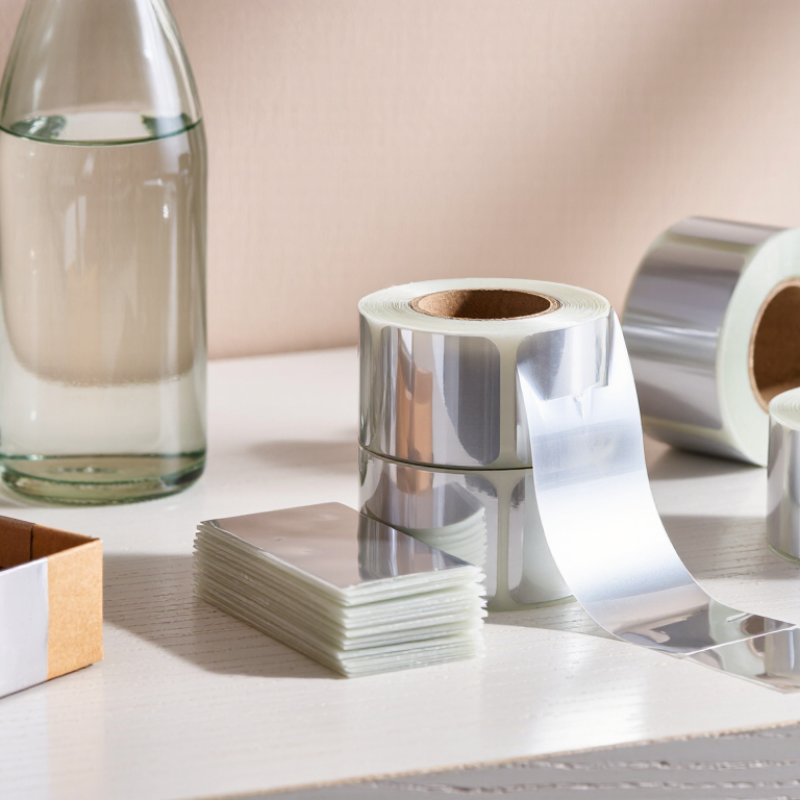
Custom cellophane self-adhesive labels are printed labels made from a thin, clear film with adhesive on the reverse. The film is traditionally cellulose-based, though the term “cellophane” is sometimes used loosely for clear label materials. Ask for the exact material specification when the distinction matters.
A clear label can let a jar’s color, texture, or contents remain visible around the printed design. It is often chosen for bottles, glass containers, and smooth packaging where an unobtrusive look is wanted. The label may be cut to a custom shape and printed with text, line art, or color. Small details need care. Pale ink can disappear against a light background, while fine lettering may be difficult to read over a busy product.
The adhesive backing allows application without separate glue. For a reliable fit, the container should be clean, dry, and smooth; dust or condensation can cause edges to lift. Not every surface behaves alike. Before ordering, check whether the material and adhesive suit the intended container, storage conditions, and printing method. A sample applied to the actual package can reveal wrinkles, glare, or alignment problems that a digital proof may miss. The clear finish looks simple, but it can expose small application flaws.
| Dimension | Description |
|---|---|
| What they are | Custom cellophane self-adhesive labels are printed labels made with a transparent or colored cellophane face material and a pressure-sensitive adhesive. They stick to a surface when pressed and do not require water or heat to activate. |
| Face material | Cellophane is a transparent film made from regenerated cellulose. Its clarity can create a “no-label” appearance on suitable containers. It is distinct from common plastic label films such as polypropylene. |
| Typical label layers | A label commonly consists of a printable cellophane face, a pressure-sensitive adhesive, and a release liner that protects the adhesive until application. The precise construction varies by product and intended use. |
| Customization options | Options can include label shape and dimensions, clear or colored film, print design, finish, adhesive type, and roll or sheet format. Availability depends on the material and converting process. |
| Printing and appearance | Printing may be applied to the film using a process compatible with the selected material. On clear labels, the container or product can show through unprinted areas; contrast and legibility depend on the artwork, ink, and background. |
| Adhesive selection | Adhesive choice should match the application surface and conditions. Glass, rigid plastics, curved containers, and textured surfaces can require different adhesive performance. Test labels on the actual packaging before ordering at scale. |
| Common uses | They can be used for product identification, packaging decoration, ingredient or product information, and promotional graphics on suitable containers and other smooth surfaces. |
| Environmental considerations | Cellophane is cellulose-based, but the environmental properties of a finished label depend on its coatings, inks, adhesive, liner, and disposal conditions. Do not assume a complete self-adhesive label is compostable or recyclable without checking the specific construction and local facilities. |
| Performance limits | Resistance to moisture, oils, abrasion, heat, and sunlight depends on the film treatment, ink, adhesive, and label design. Cellophane labels are not automatically waterproof or suitable for every environment. |
| Choosing a specification | Before selecting a label, define the surface, container shape, application method, storage and use conditions, desired appearance, and information to be printed. Confirm compatibility with samples under real-world conditions. |
Cellophane self-adhesive labels are built from thin regenerated cellulose film, a clear material made from cellulose. The film can show a product’s surface through the label, while still carrying printed text or graphics. It often receives a coating to help ink bond and to manage moisture. Coatings vary, so “cellophane” does not guarantee identical performance across labels.
A typical label has three layers: the cellophane face stock, a pressure-sensitive adhesive, and a release liner. The adhesive sits behind the film and bonds when pressed onto a clean surface. The liner protects it before use and peels away during application. A label may feel smooth and almost glass-clear, but tiny wrinkles can appear on curved jars or textured packaging. That matters. Adhesive choice should match the surface, temperature, and handling conditions. Some constructions use coatings or adhesives that affect recyclability or compostability, so the face material alone is not enough to judge disposal options. It is easy to assume transparency means simplicity; the layered structure tells a less simple story.
Custom cellophane self-adhesive labels combine a regenerated-cellulose face film, pressure-sensitive adhesive, and release liner. The film can look clear and glossy, letting a product’s color show through. “Cellophane” does not guarantee identical performance, though. Coatings, film thickness, adhesive choice, and storage conditions all affect clarity and handling.
Customization begins with matching the label to its surface and use. Flexographic printing suits repeat runs and solid colors; digital printing can make short runs and variable designs more practical. Gravure may suit long runs with detailed, consistent imagery. Printers adjust ink systems and drying settings to suit the film, then check color, registration, and adhesion on a real container. Tiny details matter. A curved jar can reveal wrinkles that a flat proof misses. Clear labels may also need a white ink layer beneath selected areas so text stays readable.
Smithers’ 2024 report, The Future of Labels to 2028, valued the global label market at about US$47.8 billion in 2023. That market-wide figure is not specific to cellophane, but it reflects the scale of demand for label production and material choices. For a custom job, request a printed proof and test it on the intended package. I would not skip that step; even a sharp design can lose contrast on a curved, reflective surface.
A sample label construction, showing the thickness of each layer in micrometers (µm).
The example combines a 30 µm cellulose film, 20 µm pressure-sensitive adhesive, and 60 µm release liner. These are illustrative specifications, not a universal standard. Customization can include printed graphics, ink colors, label shape, adhesive, and liner.
Custom cellophane self adhesive labels are clear labels designed to sit on a product’s outer packaging. Their see-through finish lets the container show through while printed text, logos, or small illustrations remain visible. A clear label can look subtle on a glass jar, but it may be harder to read on a busy or dark surface.
Food producers use them on jam jars, dry-goods bags, and bottled sauces, where a clean view of the package matters. Beauty and personal-care businesses apply them to lotion bottles, soap boxes, and sample containers. They also suit candles, stationery, handmade gifts, and small-batch crafts. The label can help a simple container feel more finished. Not every surface behaves the same.
Adhesive choice matters. A label that grips smooth glass may lift from a textured paper box, especially in humid storage or during frequent handling. For products exposed to oil, condensation, or refrigeration, test the label on the actual package before ordering a large run. Print contrast matters too: pale lettering can disappear against a clear background. That detail is easy to miss. Cellophane-style labels are not automatically suited to direct food contact; they are generally applied to the outside of packaging, with materials selected for the intended use.
Custom cellophane self adhesive labels pair regenerated cellulose film with a pressure-sensitive adhesive. Their clear, glossy surface lets product details remain visible, while the film can suit premium jars, gift boxes, and dry-goods packaging. The market context is significant: Smithers’ The Future of Global Labels Market to 2028 projected global label-market value to reach $67.9 billion by 2028. That growth reflects broad demand, not proof that every label material is environmentally preferable.
There are trade-offs. Cellophane can crease or tear more readily than some synthetic films, and moisture exposure may affect its appearance or performance. Adhesive choice matters too: residue or incompatible label layers can complicate packaging recovery. A cellulose film does not automatically make the finished label compostable or recyclable; coatings, inks, adhesives, and local processing conditions all count. That part is easy to overlook. Specifications should be tested on the actual container, especially around chilled storage, condensation, and curved surfaces.
Tips: Request samples and test them on filled packages, not flat swatches. Check adhesion after refrigeration and wiping. Ask suppliers for documented material composition and end-of-life guidance, then verify that guidance with your local waste processor. A label may look clean and simple, but its disposal route can be less straightforward.