Empowering Engineering Excellence: Innovate, Elevate, Deliver.

7 Tips for Choosing the Best Udon Noodle Machine

Choosing the right Udon Noodle Machine can shape the texture, consistency, and pace of a kitchen’s noodle preparation. A machine should do more than press dough into strips. It should handle the dough thickness and batch size you actually need, without making routine work harder. For a small restaurant, counter space and straightforward cleaning may matter as much as output. A larger operation may need steady production and durable rollers.

Looks can mislead. A heavy frame does not guarantee even noodles, and a high production claim may not reflect daily use. Check the machine’s adjustment range, materials, power requirements, safety features, and cleaning instructions. If possible, ask the supplier for a demonstration using dough similar to yours. Watch how evenly the rollers feed it, how quickly thickness can be changed, and whether scraps collect around moving parts. Small details add up.

This guide presents seven practical tips for comparing machines before you buy. It also considers maintenance, warranty coverage, operator skill, and the availability of replacement parts. These factors are easy to overlook when a machine seems like a good deal. Your needs may change, too. A choice that works today might feel limiting after a busy season. Use the tips to weigh real kitchen conditions against the product’s specifications, and verify important claims with the manufacturer or a qualified dealer.
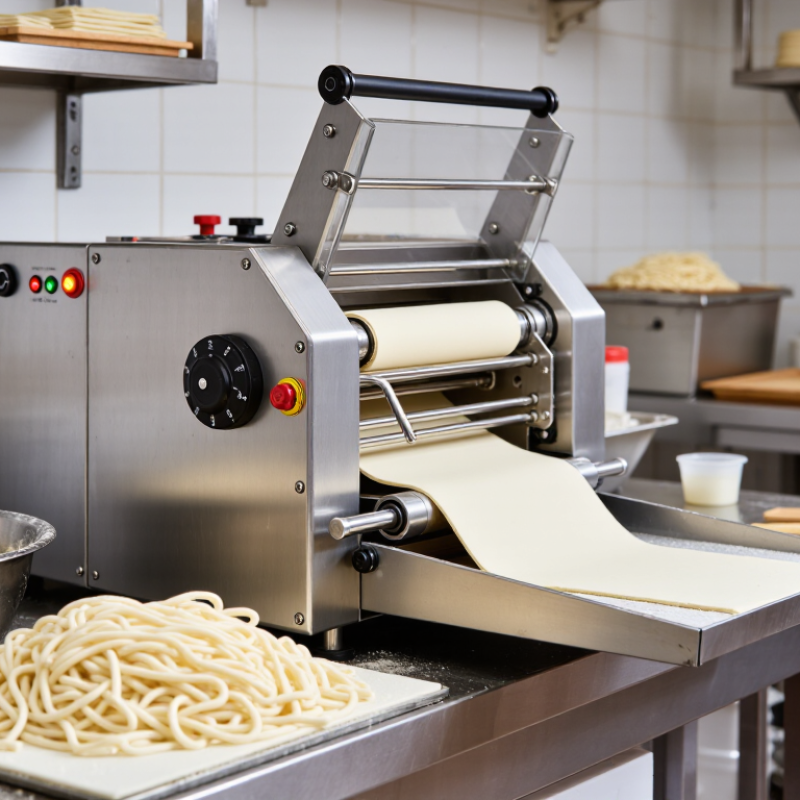
7 Tips for Choosing the Best Udon Noodle Machine

Match Rated Capacity to Demand: Compare Output in kg/h and Batch Size

A machine’s rated output is a starting point, not a daily production promise. Compare kilograms per hour with the batch size your kitchen can mix, rest, and feed consistently. The World Instant Noodles Association reported 123.1 billion servings of instant noodles consumed worldwide in 2023. That figure is not a measure of udon demand, but it shows why broad noodle-market numbers should not replace your own sales forecast.

Run a practical calculation: 80 kg/h × five productive hours × 75% operating efficiency gives about 300 kg per shift. The 75% figure is an example, not an industry benchmark. Allow time for dough changes, cleaning, minor jams, and staff breaks. Batch size matters, too. A 20 kg batch feeding an 80 kg/h line lasts only 15 minutes at full rate. Can your mixer and operators keep up? A gap here can leave an expensive machine waiting.

The National Restaurant Association’s 2024 State of the Restaurant Industry report projected US restaurant sales of $1.1 trillion for 2024; this is sector-wide context, not a forecast for udon. Use your own peak-hour orders to size equipment. Ask suppliers to explain rated capacity under your dough formula, noodle thickness, and operating conditions. Request a timed production trial, then weigh saleable noodles—not dough entering the machine. I would still leave a little headroom. Kitchens are rarely as tidy as spreadsheets.

Check Dough Compatibility: Udon Hydration Commonly Falls Near 40–50%

Udon dough is firm, so check whether a machine can handle roughly 40–50% hydration, measured as water weight against flour weight. At 45% hydration, 10 kilograms of flour needs about 4.5 kilograms of water. That is a useful bench test, not a universal recipe. Flour protein, room temperature, and salt solution can change how the dough feels. A machine that handles soft pasta dough may still struggle with a tight udon mix. Ask for its recommended hydration range and test with your own flour before buying.

Use a small, repeatable trial. Weigh the flour and water, mix for the same time, then check for dry pockets and uneven clumps. AACC International’s Approved Method 54-21.02 uses a 500-Brabender-Unit endpoint to assess flour water absorption with a farinograph. That standard offers a useful measurement framework, but it does not prescribe an udon formula. Keep that distinction clear. A machine’s advertised capacity alone tells little about dough performance. Still, the 40–50% range is only a starting point; I would retest after changing flour lots. Small differences show.

Assess Sheeting and Cutting: Verify Adjustable Thickness and Noodle Width

A good udon machine should let you control both sheet thickness and cutter width. These settings shape cooking time, bite, and portion consistency. Japan’s Agricultural Standards for dried noodles use 1.7 mm as the width threshold for udon classification. Treat that figure as a useful reference, not a universal fresh-udon target. Fresh noodles may need different dimensions for your dough, serving style, and kitchen workflow. Check the machine’s adjustment range against the noodles you actually plan to make.

Tips: Ask for the minimum and maximum sheet thickness, plus the available cutter widths. Run a small batch at two settings. Measure the dough sheet with a ruler, then inspect several cut strands for uneven edges. A dial alone proves little. Repeat the test after cleaning and resetting the machine; small alignment shifts can change the result. For a more reliable comparison, record cooking time and noodle texture for each setting. AACC International’s noodle-quality methods assess cooked texture and cooking loss, useful checks when comparing batches. Don’t skip the wet test. A setting that looks precise on dry dough may behave differently once the noodles cook.

7 Tips for Choosing the Best Udon Noodle Machine - Assess Sheeting and Cutting: Verify Adjustable Thickness and Noodle Width

Tip What to Assess Practical Check Suggested Acceptance Guide
1. Check thickness adjustment The roller gap and the available dough-sheet thickness settings. Run dough at three or more settings, then measure each sheet with a ruler or caliper at several points. Settings should be repeatable and cover the thicknesses required by your recipe; a sample test range such as 2–6 mm can help compare models.
2. Verify noodle-width options Available cutter widths and whether cutters can be changed or adjusted. Measure at least 10 cut noodles from each setting and compare their widths. Choose a cutter that produces the width your recipe requires. About 3–5 mm is a useful starting range for many udon styles, but preferences vary.
3. Test thickness consistency Uniformity across the width and length of the dough sheet. Take measurements near both edges and the center of a test sheet after it has passed through the rollers. Look for even sheets without pronounced thin spots, thick ridges, or tearing; set a tolerance based on your product specification.
4. Inspect cut quality Whether strands separate cleanly and retain a consistent shape. Cut a small batch and check for joined strands, ragged edges, or flattened noodles. Most strands should separate easily, with no recurring bunching or cutting defects during a continuous test.
5. Confirm setting repeatability Whether the same thickness and width can be reproduced after changing settings or restarting. Record a setting, run a test, change the setting, then restore it and compare the new batch with the first. The restored setting should produce measurements close to the original batch; use a tolerance appropriate to your recipe and equipment.
6. Match the dough to the machine The machine’s handling of your dough’s hydration, firmness, and batch size. Test with your intended recipe and feed the dough gradually, watching for slipping, sticking, or strain. The dough should feed and sheet steadily without frequent manual correction; confirm operating limits in the equipment specifications.
7. Check cleaning and cutter access How easily rollers and cutting parts can be reached, removed, and cleaned. Ask for a cleaning demonstration and check the manufacturer’s instructions for removable parts and wash restrictions. Food-contact surfaces should be accessible for routine cleaning, and parts should be reassembled securely before operation.

Note: The measurement ranges are example evaluation guides, not universal specifications. Confirm the required noodle dimensions and operating limits for your recipe and production needs.

Prioritize Food-Contact Safety: Check Compliance with EU Regulation 1935/2004

Udon dough presses against rollers, cutters, and the inside of a hopper. These parts need documented food-contact suitability, not just a polished surface. EU Regulation 1935/2004 requires materials to avoid transferring substances in amounts that could endanger health or unacceptably change food’s composition, taste, or smell. Ask the supplier for material declarations, traceability details, and relevant migration-test reports. Check that documents cover each food-contact part, including seals and coatings. A general machine certificate may not be enough.

Look for evidence tied to the materials actually used. Requirements differ by material, and EU rules do not provide equally detailed, harmonized measures for every type. The European Commission’s 2022 Fitness Check identified gaps and unevenness in the food-contact materials framework. That makes specific documentation important. Read the test conditions, too: a report for a different temperature, food type, or contact duration may not reflect noodle production. The European Food Safety Authority’s 2022 Eurobarometer found that 32% of respondents were concerned about microplastics in food. That figure is not evidence of machine-related contamination, but it shows why clear answers matter. Ask how the supplier controls material changes and replacement parts. I would still verify the paperwork independently. Paperwork can be incomplete. Inspect accessible surfaces for worn coatings, trapped dough, or damaged seals during routine cleaning.

Review Machine Safety: Verify Guards and Electrical Design Against ISO 14120 and IEC 60204-1

When evaluating an udon noodle machine, inspect its guards while the machine is running only under safe, controlled procedures. ISO 14120 addresses the design and construction of guards, including their strength, fastening, and access prevention. Check that covers around rollers, cutters, and drive belts cannot be removed casually or leave reachable pinch points. Look for sharp edges, loose hinges, and gaps where dough or fingers could enter. Small details matter.

Ask for the risk assessment and documentation showing how each guard was selected. If access doors use interlocking devices, verify that the machine’s design addresses those devices and prevents hazardous motion when access is opened. ISO 14120 alone does not confirm every safety function. Have a qualified professional review the complete setup.

Electrical design deserves the same close attention. IEC 60204-1 covers electrical equipment of machinery, including protection against electric shock, wiring, and control-circuit practices. Check for a clearly identified disconnect, sound protective grounding, secure cable entries, and labeled controls. Inspect the cabinet for moisture or flour-dust exposure, especially near washdown areas. Ask how emergency stops behave and how power returns after an outage. Paperwork helps, but it can miss a practical hazard; watch a trained operator perform normal cleaning and changeover, then note what still feels awkward.

7 Tips for Choosing the Best Udon Noodle Machine

Review Machine Safety: Verify Guards and Electrical Design Against ISO 14120 and IEC 60204-1

How to read this chart: A value of 1 indicates that the topic is within the standard’s general scope; 0 means it is not that standard’s primary focus. This is a scope guide, not a compliance rating. Check the applicable editions and requirements for the machine.

Download
Brochure