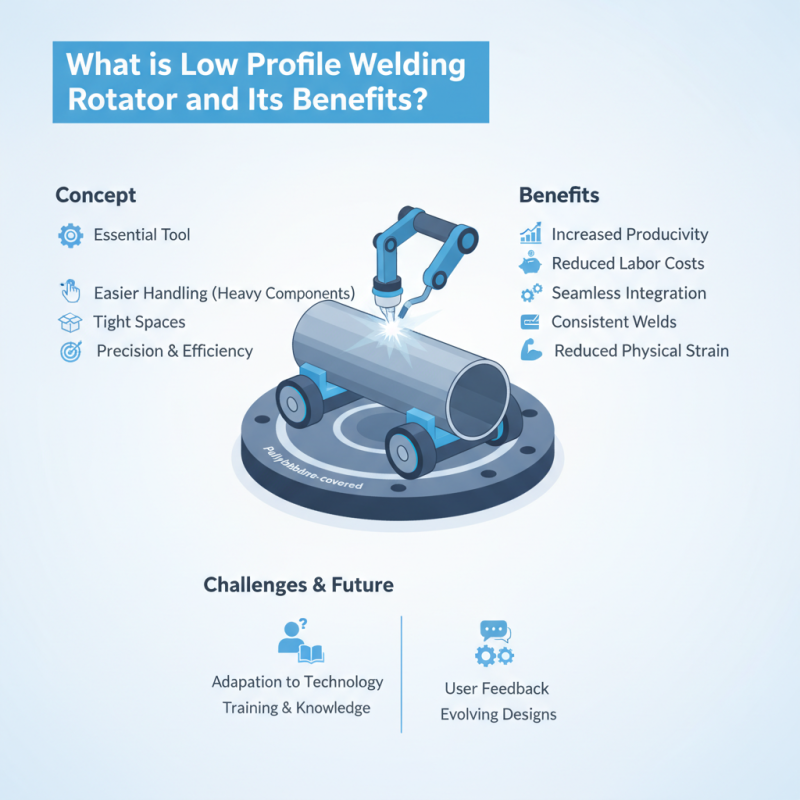
What is Low Profile Welding Rotator and Its Benefits?
The "Low profile welding rotator" is an essential tool in modern welding applications. Its design allows for easier handling of heavy components, especially in tight spaces. This unique equipment is beneficial for industries requiring precision and efficiency.
Using a low profile welding rotator enhances productivity and reduces labor costs. The rotator’s low height enables seamless integration into various work environments. Operators can achieve more consistent welds without excessive physical strain.
Despite its advantages, operators might still face challenges adapting to this technology. Proper training and knowledge are crucial for maximizing its use. Continuous feedback from users can improve designs and functionality, ensuring the equipment evolves along with industry needs.
What is a Low Profile Welding Rotator?
A low profile welding rotator is a specialized piece of equipment used in various welding processes. Its primary function is to assist in the rotation of heavy cylindrical objects, making it easier for welders to reach different angles. This tool is particularly useful in tight spaces where standard rotators may not fit or operate effectively. The low profile design allows for a stable and secure positioning of the workpieces, reducing the risk of accidents.
These rotators provide several benefits. They enhance efficiency by allowing welders to work more comfortably and reduce the time spent on adjusting their positions. Operators can focus on their welding tasks without frequently repositioning the material. Additionally, the low profile design often accommodates larger and heavier objects that traditional equipment cannot handle. This versatility is crucial for industries that work with various materials and sizes.
Despite these advantages, it's essential to consider the limitations. For smaller projects, the size and capacity may be overkill. Not every shop requires such specialized equipment. Therefore, evaluating specific project needs is vital before investing. Ultimately, understanding the value of a low profile welding rotator can lead to more efficient operations, fostering a safer work environment.
Key Features of Low Profile Welding Rotators
Low profile welding rotators are essential tools in the welding industry. They provide stability and precision for various welding projects. These rotators help in the effective handling of cylindrical objects, ensuring uniform welds and minimizing errors. Their low height is particularly advantageous, allowing for easier access and handling during operations.
One key feature of low profile welding rotators is their adjustable speed control. This enables operators to tailor the rotation speed to match the specific requirements of each project. Additionally, many models are designed with a robust, sturdy construction that supports heavy loads while maintaining balance. The ability to accommodate different sizes and shapes of workpieces is critical.
Safety is also paramount when using these devices. Proper design features promote safe handling and minimize the risk of accidents. However, users sometimes overlook the importance of regular maintenance. Neglecting routine checks can lead to inefficiencies or even failures in performance. It’s crucial to reflect on these aspects to ensure optimal operation and to extend the lifespan of the equipment.
Benefits of Low Profile Welding Rotators
Benefits of Using Low Profile Welding Rotators
Low profile welding rotators are specialized tools designed for accommodating heavy cylindrical workpieces with minimal height. These rotators enhance safety and efficiency in welding applications. Their unique design allows for better access to welded joints, making the process smoother. Professionals frequently encounter tight spaces, where low profile rotators excel.
One significant benefit of using low profile welding rotators is their ability to handle larger loads. They provide better stability for heavy components, reducing the risk of tips and accidents. This stability allows welders to focus on precision rather than worrying about equipment instability.
Tips: Ensure the rotator's weight capacity is adequate for your workpiece. Regular maintenance checks on the motor and wheels can prevent unexpected failures.
These tools also improve ergonomics. Workers can weld without bending or stretching excessively, reducing fatigue. However, it's crucial to assess if your workspace can accommodate the maneuverability of these rotators. In some cases, workers may feel confined, which could hinder their performance.
Tips: Consider the workspace layout when integrating low profile rotators. Creating ample space around the equipment can enhance workflow efficiency.
Applications of Low Profile Welding Rotators in Industries
Low profile welding rotators play a crucial role in various industries today. These devices are designed to facilitate efficient welding processes for cylindrical objects. They are particularly beneficial in tight spaces where traditional rotators cannot fit. Their low height ensures that they can accommodate equipment without hindering accessibility.
In the manufacturing sector, low profile welding rotators are commonly used for fabricating tanks, pipes, and large components. They provide stability and precision during welding, which enhances the final product's quality. Moreover, the adjustable speed settings allow operators to fine-tune the rotation for different welding techniques, ensuring versatility in production.
The automotive industry also exploits the advantages of these rotators. They improve safety and efficiency in assembly lines by allowing workers to position heavy parts securely. However, reliance on automated systems can sometimes lead to oversight. Operators must remain vigilant to prevent mechanical failures that could impact operations. Overall, low profile welding rotators streamline processes while still demanding attention to detail from skilled workers.
Comparison with Conventional Welding Rotators
Low profile welding rotators are increasingly popular in industrial settings. They are specifically designed to handle cylindrical objects such as tanks and pipes. The low profile design allows for better clearance and stability during the welding process. Compared to conventional rotators, they provide a lower center of gravity, enhancing safety and reducing the risk of tipping.
When comparing low profile welding rotators with traditional options, several benefits stand out. Low profile models typically have a compact design, allowing them to fit into tighter spaces. They also often come with adjustable speed controls, giving operators more precision during the welding process. These features can contribute to improved efficiency and higher quality welds. However, some may find these rotators less versatile compared to their conventional counterparts.
Tips: Consider the type of projects you commonly undertake. Evaluate whether a low profile rotator suits your needs. It's essential to think about weight and size limitations in your workspace. Always prioritize safety by ensuring proper training for operators. This can prevent accidents and enhance operational efficiency.