Empowering Engineering Excellence: Innovate, Elevate, Deliver.
Choosing an Industrial Chain Conveyor for global operations requires more than comparing prices and catalog photos. The right system must match product weight, transfer distance, speed, layout, and working environment. A conveyor moving steel parts needs different chains and supports from one carrying cartons or pallets. Wet rooms, dust, heat, and frequent washdown also change the specification.
Experienced buyers usually begin with verified operating data. Record the heaviest load, average load, product dimensions, cycle time, and daily running hours. Then review chain pitch, drive capacity, frame strength, guarding, lubrication access, and spare-part availability. Supplier experience matters too. Ask for drawings, load calculations, factory test records, installation guidance, and references from comparable industries. A clear inspection plan can prevent costly surprises after shipment.
Small details matter.
Global procurement adds practical concerns. Confirm electrical requirements, packaging quality, delivery terms, documentation, and local service support before placing an order. A low purchase price may hide complex installation or long replacement times. Total cost should include energy use, maintenance labor, downtime risk, and consumable parts. However, no selection guide is perfect. A neat calculation can still miss product impact, uneven loading, or future capacity changes. Recheck assumptions with operators and maintenance teams. Their daily observations often reveal problems that specifications overlook. Reliable decisions come from measurable requirements, honest supplier communication, and careful testing before full-scale production.
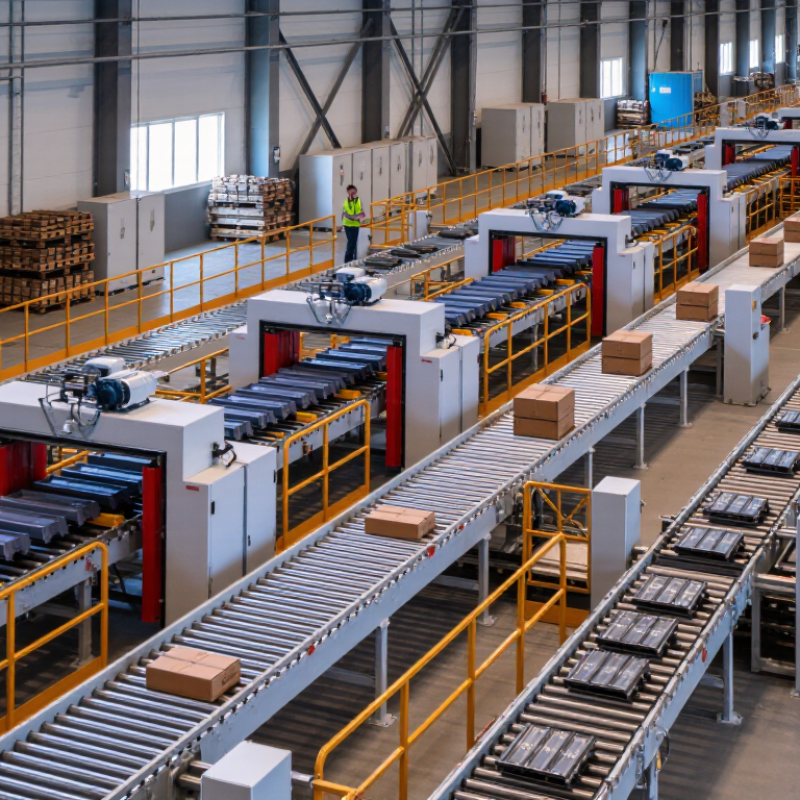
An industrial chain conveyor moves products through a continuous chain loop. The chain runs over sprockets, which transfer motor power into movement. Flights, slats, or attachments carry the load along the conveying path. Guide rails control product position and reduce unwanted sway. The drive unit should match load weight, speed, incline, and operating hours.
Selection begins with the material, not the conveyor frame. Boxes, pallets, hot parts, and wet containers require different chain surfaces. Measure product length, width, weight, and contact area carefully. A small dimension error can cause jams at transfers.
Check the required speed in meters per minute. Also consider cleaning methods, ambient temperature, dust, and moisture. These details affect chain material, lubrication, guarding, and motor protection.
Global buyers should request load calculations, layout drawings, inspection records, and operating instructions. Confirm the electrical supply and applicable safety requirements before purchase. Ask how chain tension is adjusted and how worn sprockets are replaced. A larger motor is not automatically safer. It may increase shock loads, energy use, and maintenance stress. In practice, even a careful design can overlook product instability near a bend. Trial testing with the real product is valuable. Leave access around the drive and return sections. It saves time later.
Defining material handling requirements starts with the product, not the conveyor frame. Record product weight, dimensions, surface condition, temperature, and packaging stability. A fragile carton needs controlled acceleration. A hot metal component needs heat-resistant chains and guarded transfer points. Also measure the required throughput in units per minute, not only tons per hour. This prevents a common mistake: choosing capacity for average production instead of peak demand.
Production requirements need equal attention. Map every loading, inspection, accumulation, and discharge position before requesting quotations. The conveyor should match takt time, line speed, shift length, cleaning routines, and maintenance access. MHI’s 2024 Annual Industry Report identifies automation and robotics among the leading supply-chain investment priorities. The International Federation of Robotics recorded 541,302 industrial robot installations worldwide in 2023. These figures suggest stronger automation demand, but automation cannot repair poor process data.
In practical factory assessments, small gaps often become expensive. A narrow transfer may damage cartons. A poorly placed sensor may stop the entire line. Specify allowable noise, safety guarding, controls integration, and spare-part availability for each operating region. Leave room for inspection. My own preference is conservative sizing, yet oversizing can waste energy and floor space. Recheck accumulation length, especially when upstream and downstream speeds differ.
Industrial chain conveyors should be compared by task, not appearance. I have inspected lines where narrow conveyors handled heavy steel bins poorly. Load weight, pitch, speed, and transfer spacing reveal the real requirement. Roller chains suit demanding loads and controlled movement. Slat chains handle containers and products needing continuous support. Hinged belts can reduce product damage, but they may require more careful cleaning.
Material choice changes service life. Carbon steel offers strength for dry, abrasive areas. Stainless steel resists corrosion and supports washdown environments. Plastic chain can reduce noise and protect delicate surfaces. Check temperature, chemicals, moisture, and expected impact before choosing. A polished surface is not automatically better. Sometimes it hides weak joints.
Drive systems also deserve a practical comparison. Direct drives usually save space and simplify alignment. Geared motors provide useful torque at low conveyor speeds. Variable-frequency drives allow gentler starts and adjustable throughput. However, extra controls increase commissioning work and maintenance skill requirements. Ask about overload protection, emergency stops, guarding, and spare-part access. Local safety rules still apply.
I often build a comparison table using load, speed, noise, cleaning time, energy use, and service access. Then I test the worst case, not the average product. A wet, heavy load exposes design mistakes quickly. No option is perfect. Record chain wear during early production runs, and question any specification that seems convenient.
Choosing an industrial chain conveyor requires more than matching load weight and line speed. Safety should lead the assessment. Review guarding, emergency stops, nip points, access doors, and lockout procedures against ISO 12100 and ISO 13849-1. OSHA’s lockout/tagout rule, 29 CFR 1910.147, also requires controlled energy isolation during servicing. The U.S. Bureau of Labor Statistics recorded about 2.6 million nonfatal private-industry injuries in 2023. Conveyor risk is only one part, but it deserves practical testing.
Capacity must reflect real operating conditions, not catalogue figures. Calculate product weight, pitch, accumulation, incline, starts per hour, and peak demand. A chain rated for 500 kilograms may perform poorly with shock loading or uneven pallets. Maintenance access matters too. The U.S. Department of Energy reports that preventive maintenance can reduce costs by 12–18% compared with reactive work. Still, I would not trust this percentage blindly. Dust, washdown, temperature, and operator habits can change the result.
Tips: Request a guarded test section with your heaviest product. Measure noise, chain vibration, start-up current, and transfer stability. Ask for spare-part lead times and maintenance hours per month. Build total cost from installation, electricity, lubrication, labor, downtime, and replacement parts. MHI’s 2024 Industry Report found that 55% of supply-chain professionals planned to increase technology investment. Investment alone is not capacity. A cheaper conveyor can become expensive when one worn sprocket stops the whole line. Test the weak points first.
Comparative planning data for selecting common industrial chain conveyor configurations
| Conveyor configuration | Typical applications | Indicative capacity | Typical speed | Load and layout capability | Key safety requirements | Maintenance profile | Indicative installed cost | Five-year TCO index* | Best fit for global buyers |
|---|---|---|---|---|---|---|---|---|---|
| Pallet chain conveyor | Pallet handling, assembly lines, warehouse transfer, automotive and heavy-unit movement | Approximately 10–60 pallets/hour, depending on pallet spacing and accumulation strategy | 0.05–0.50 m/s | Typically 500–3,000 kg per metre; suitable for straight runs, transfers, stops and accumulation zones | Fixed guarding at nip points, emergency stops, anti-restart control, overload protection and safe access for pallet removal | Weekly visual checks; chain lubrication commonly every 250–500 operating hours; inspect sprockets, chain elongation and guide rails | Approximately USD 1,000–3,500 per metre, excluding major building modifications | 100 | Projects requiring high load capacity, robust accumulation and long service life |
| Slat-top chain conveyor | Bottles, cans, cartons, containers, packaging lines and hygienic production areas | Approximately 30–300 units/minute, depending on product size, accumulation and number of lanes | 0.10–0.60 m/s | Typically 10–150 kg per metre; supports curves, transfers, multiple lanes and controlled accumulation | Guard moving chains and sprockets; use product-sensitive accumulation, emergency stops and suitable food-contact materials where required | Frequent cleaning in hygienic areas; inspect wear strips and chain condition; lubrication intervals depend on material, washdown and operating temperature | Approximately USD 700–2,500 per metre, excluding fillers, sensors and special sanitation features | 92 | Packaging and consumer-goods lines where flexibility, accumulation and sanitation are important |
| Drag or flight chain conveyor | Bulk solids such as grain, wood chips, ash, minerals and process residues | Approximately 10–300 tonnes/hour, determined by material bulk density, trough size and chain speed | 0.10–0.50 m/s | High bulk-load capability; can handle enclosed horizontal transport and moderate inclines when properly designed | Enclose the conveying path; provide pull-cord stops, blockage detection, overload protection, dust control and safe inspection access | Inspect flights, chain, liners and sprockets; remove material buildup; lubrication and wear checks are critical in abrasive or dusty service | Approximately USD 1,500–5,000 per metre, depending on enclosure, wear lining and duty rating | 118 | Bulk-material operations prioritizing containment, high throughput and resistance to harsh conditions |
| Overhead chain conveyor | Paint shops, garment handling, automotive components, curing ovens and parts transfer | Approximately 20–200 carriers/hour, depending on pitch, speed and loading cycle | 0.02–0.30 m/s | Typically 50–200 kg per carrier; uses overhead space and can include vertical lifts, curves and accumulation sections | Guard accessible moving sections; control suspended-load hazards; install emergency stops and provide lockout access at service points | Inspect trolley wheels, chain, track and hangers; lubrication is commonly required every 250–500 operating hours, depending on duty and environment | Approximately USD 1,200–4,500 per metre, excluding structural supports, carriers and process equipment | 110 | Facilities with limited floor space and repeatable part routing between process stations |
| Roller chain conveyor | Heavy cartons, totes, pallets, drums and unit loads requiring stable bottom support | Approximately 5–40 loads/hour for heavy-unit handling; higher rates are possible with accumulation and controls | 0.05–0.50 m/s | Typically 100–2,000 kg per metre; suitable for straight transport, transfers, stops and indexing applications | Guard drive components and pinch points; use photoelectric sensing, emergency stops, overload protection and controlled restart logic | Check chain tension, sprockets, rollers and bearings; lubrication frequency commonly ranges from 250–1,000 operating hours | Approximately USD 900–3,000 per metre, depending on roller diameter, frame strength and controls | 96 | Heavy unit-load movement where predictable transport and moderate-to-high load capacity are required |
How to interpret the figures
*The five-year TCO index uses the pallet chain conveyor as the reference value of 100. A lower index indicates a lower indicative ownership cost under comparable operating conditions. The index considers purchase, installation, energy, routine maintenance and commonly replaced wear parts; it excludes buildings, taxes, downtime losses and process equipment.
Installed-cost ranges are broad planning estimates in USD per metre for standard industrial installations. Actual pricing varies with conveyor length, width, chain material, controls, guarding, sanitation requirements, local labor, freight, import duties and site conditions.
Before purchase, verify the design against applicable local regulations and recognized machinery-safety principles, including risk assessment, guarding, emergency stopping, safe isolation and access for maintenance. Capacity must be confirmed using the actual product weight, dimensions, bulk density, friction, incline, duty cycle and accumulation requirements.
Choosing an industrial chain conveyor begins with the supplier, not a colorful catalog. A reliable global supplier should explain load capacity, chain speed, frame material, and operating temperature clearly. Ask for drawings, test records, and installation references from factories with similar conditions. Their engineers should discuss dust, moisture, product size, and cleaning routines before proposing a model. This conversation reveals experience. Avoid vague promises.
Check whether quality controls are documented at each production stage. Important evidence includes material certificates, weld inspections, dimensional checks, and a recorded trial run. Request a sample inspection report, not only polished photographs. A dependable supplier identifies likely failure points, such as chain elongation, poor alignment, or inaccessible bearings. They should provide spare-parts lists, maintenance intervals, manuals, and remote commissioning support. Clear communication matters when time zones and technical languages differ. Slow replies can become expensive.
Evaluate the full delivery process, including packaging, export documents, delivery terms, and defect-response procedures. The supplier should state warranty boundaries without hiding difficult conditions in small clauses. Ask how they handle design changes after approval. That answer matters. I would request a factory video call, but I would not treat it as final proof. Independent inspection may still be sensible before shipment. A supplier can be technically capable yet unsuitable for your site. In practice, even careful reviews miss small installation risks. Review past projects carefully, then compare promises with measurable evidence.