Empowering Engineering Excellence: Innovate, Elevate, Deliver.

How to Choose the Right Spiral Slide for Your Playground?

Choosing a Spiral Slide is not just a matter of picking a bright color or dramatic shape. The right model should fit the children, the available space, and the playground’s layout. Playground researcher Dr. Joe Frost’s work emphasizes the developmental value of play. A practical paraphrase of that principle is: “Choose a challenge that suits the child, not just the space.” This is a paraphrase, not a verbatim quotation.

Start with the basics: check the slide’s intended age range, platform height, exit area, and overall footprint. Measure the space on the ground, then consider the height and the route children take to reach the entrance. A tight corner can make a tall slide feel imposing, while a clear view helps caregivers keep an eye on the landing zone. Fit matters most.

Compare materials and construction details, too. A molded plastic chute may feel different under the sun than a metal one, and surface temperature deserves attention in hot climates. Ask the supplier for installation requirements, maintenance guidance, and relevant product testing information. Confirm that the structure works with the surrounding equipment, surfacing, and site conditions.

Not just looks. A visually striking Spiral Slide can still be the wrong choice if its exit crowds a walkway or its dimensions exceed the planned area. Even careful planning has limits; real children may use equipment in ways designers did not expect. That is worth reflecting on. The sections ahead explain how to weigh safety, age suitability, materials, space, and long-term upkeep before choosing a slide.
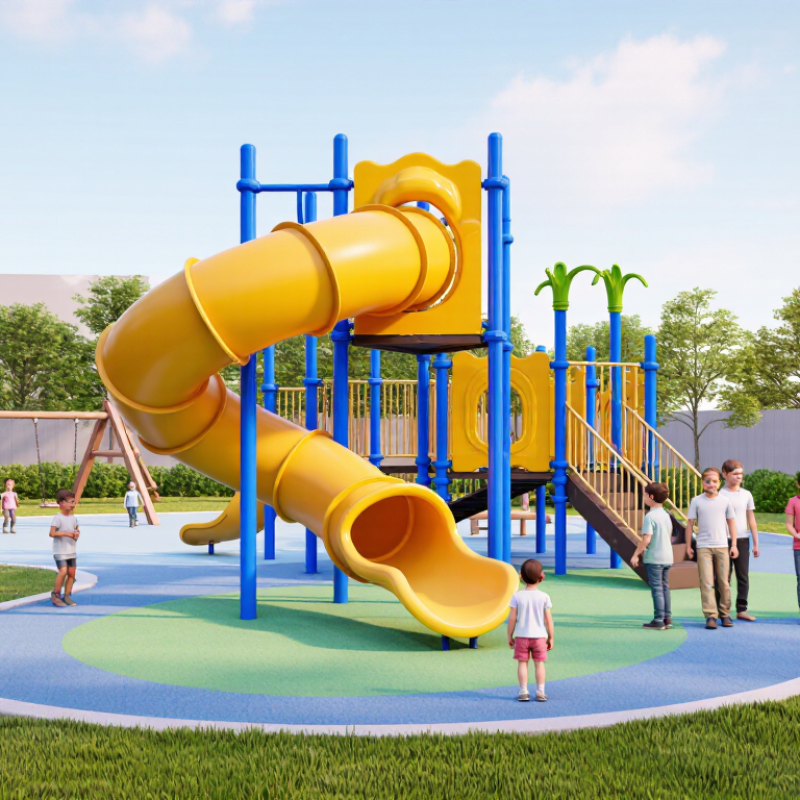
How to Choose the Right Spiral Slide for Your Playground?

Understanding Spiral Slide Types and Their Design Features

Spiral slides generally come in two forms: open chutes and enclosed tubes. Open spirals let children see the play area as they descend. Raised sidewalls help guide the ride, but some children may feel exposed. Enclosed tubes create a more sheltered route and can fit into compact play spaces. Their interiors may feel dark, though. Small detail, big difference. A visible entrance and exit help children understand where the slide begins and ends.

Look closely at the curve, not just the color or height. A tight spiral takes less room, while a wider curve may feel less abrupt. The number of turns, slide diameter, and transition from platform to chute all affect the ride. Check that the exit leads into a clear landing area, away from walkways and nearby equipment. Materials also matter: surfaces should handle regular use and changing weather without becoming rough or overly hot. There is no universally best type. A design that works for older, confident riders may feel challenging to younger children, so match the slide’s shape and height to the playground’s age group and available space. Some plans look perfect on paper; the real test is how children move through them.

How to Choose the Right Spiral Slide for Your Playground?

Indicative platform-height planning ranges by spiral slide design

The bars show example deck-height ranges in metres, not fixed industry standards. Compact open slides can suit lower platforms, while larger open or enclosed tube designs may be planned for taller platforms. Confirm the selected slide’s specifications, age suitability, use zone, and local playground safety requirements before installation.

Assessing Playground Space, Age Groups, and User Capacity

Begin with the space you can actually protect, not just the slide’s footprint. Measure the platform height, slide runout, and required clear-use zone. A spiral slide may fit beside a tower, yet its curved exit can extend into a walkway or swing area. Leave room for circulation. Compare the site plan with the installation drawings, including entry and exit clearances.

Age matters as much as height. For younger children, look for an accessible entry, enclosed sides, and a landing that does not send riders into crowded traffic. Older children may enjoy a taller, faster-feeling curve, but speed also depends on slide geometry and user behavior. Do not rely on age labels alone. Check the equipment’s intended age range and ask a qualified playground professional to review the layout.

Estimate peak use during recess or community events, not during a quiet hour. Consider how many children can queue safely and whether the platform serves several routes without bottlenecks. A slide’s stated capacity is not the same as safe site capacity. Crowding changes everything. If children wait on steps or cluster at the exit, reconsider circulation, supervision, or the layout. This detail is easy to underestimate. Recheck measurements after installation; real paths can differ from the drawing.

How to Choose the Right Spiral Slide for Your Playground? — Assessing Playground Space, Age Groups, and User Capacity

Use this table as an early planning guide. Footprints and platform heights are approximate examples, not product specifications; confirm dimensions, age suitability, and required use zones with the slide supplier and applicable local safety requirements.

Planning factor Compact option Medium option Large option What to check before choosing
Typical user age Preschool children, commonly ages 2–5 School-age children, commonly ages 5–12 Older school-age users, commonly ages 8–12 Use the age range specified for the complete play structure. Separate play areas where younger and older children share a site.
Example platform height About 4–5 ft (1.2–1.5 m) About 5–6 ft (1.5–1.8 m) About 6–8 ft (1.8–2.4 m) Match the platform height to the intended age group, structure, and site requirements. Greater height can affect fall exposure and supervision needs.
Approximate slide footprint Roughly 8 × 10 ft (2.4 × 3.0 m) Roughly 10 × 12 ft (3.0 × 3.7 m) Roughly 12 × 14 ft (3.7 × 4.3 m) These are preliminary space estimates for the slide area only. They do not include the full playground use zone, access routes, or other equipment.
Approximate spiral diameter About 6–8 ft (1.8–2.4 m) About 8–10 ft (2.4–3.0 m) About 10–12 ft (3.0–3.7 m) Ask for the actual outside dimensions, entry orientation, exit location, and required clearances for the specific slide design.
Space and layout fit Works best in a smaller play zone with a clear approach and exit path. Needs room for the spiral, a visible entry point, and an uncluttered landing area. Requires more room around the structure and careful coordination with nearby equipment and circulation routes. Measure the usable site, including slopes, paths, landscaping, fences, and existing play equipment. Do not treat the slide footprint as the total required space.
User capacity and queueing Plan for one child on the slide at a time; provide a small, clearly defined waiting area. Plan for one child on the slide at a time; assess whether a separate queue or additional play activity is needed. Plan for one child on the slide at a time; high-traffic sites may benefit from multiple activities or another slide to reduce waiting. Slide capacity is not the same as playground capacity. Keep the entrance and exit clear, discourage climbing up the slide, and follow posted supervision guidance.
Visibility and supervision Keep the entry and exit easy for caregivers to see. Check that the spiral walls and nearby equipment do not hide the entry, exit, or waiting children. Review sightlines from seating and common supervision points; a larger structure can create more visual barriers. Consider caregiver locations, shade, busy paths, and whether adults can observe both the platform and slide exit.
Best-fit site profile Limited space, younger users, and modest expected demand. Moderate space and mixed or school-age use with regular play activity. Generous space and higher expected use by older children, subject to site and safety checks. Choose based on measured space, intended ages, expected traffic, and the complete play-area layout—not slide height alone.

All dimensions are illustrative planning ranges. Final selection and installation should be based on the manufacturer’s drawings, site conditions, applicable playground safety standards, and required inspection procedures.

Comparing Materials, Dimensions, and Slide Configurations

How to Choose the Right Spiral Slide for Your Playground?

Comparing Materials, Dimensions, and Slide Configurations

Material choice affects comfort, maintenance, and long-term performance. Stainless steel resists impact and heavy use, but its surface can become hot in direct sun. Molded plastics, such as HDPE, offer smoother surfaces and varied colors; ask suppliers for UV-resistance and weathering documentation. Check joints and transitions, too. Small gaps can become maintenance problems.

Dimensions shape both play and safety. Measure the available fall zone, platform height, and slide exit before selecting a model. The U.S. Consumer Product Safety Commission’s Public Playground Safety Handbook recommends a six-foot use zone around most equipment, with specific guidance and exceptions for slides. Confirm the slide’s exit clearance against the current handbook and applicable ASTM F1487 requirements. A compact spiral may fit a small site, while a taller, wider chute needs more space and a suitable access platform.

Open spiral slides give caregivers a clearer view of children, while enclosed configurations may feel more sheltered. Compare chute width, curve radius, and entry height against the age range and expected traffic. Ask for load, installation, and inspection specifications—not just a product drawing. In practice, drawings can hide awkward sightlines. Walk the site and picture a child entering, turning, and exiting before committing.

Checking Safety Standards, Fall Zones, and Accessibility

Before selecting a spiral slide, confirm that its design and installation meet current playground safety standards for your region. Ask for documentation covering the intended age range, platform height, guarding, openings, materials, and maintenance checks. A certificate alone cannot show whether the installed slide suits your site. Check that joints are smooth, sidewalls are intact, and the entry platform has no hazardous gaps. Keep the slide clear of hard borders and nearby equipment. Small details matter.

Map the fall zone using the slide manufacturer’s specified dimensions, then verify it on the ground before installation. The exit should lead onto impact-attenuating surfacing, not a path, bench, or exposed concrete edge. For accessibility, consider the route to the play structure, transfer points, and space for a companion to assist. A spiral shape may offer an engaging ride, but it does not make an elevated deck accessible by itself. Check route width and surface firmness with intended users; this part is easy to overlook. No setup fits everyone.

Planning Installation, Inspection, and Ongoing Maintenance

A spiral slide should fit the playground’s age range, available space, and expected traffic. Before installation, measure the full slide and its exit area, not just the tower opening. Check that the surrounding surfacing is level, drains well, and provides the required fall space. Follow the slide maker’s installation instructions, especially for support points, fasteners, and anchoring. A loose connection can create movement that is hard to notice from a distance. Small details matter. A common planning mistake is leaving too little room for children to exit and move away safely. Recheck the layout before pouring or fixing anything in place.

Inspection should be part of the operating routine, not a task saved for visible damage. Look for cracks, sharp edges, loose bolts, worn joints, and debris inside the chute. Pay close attention to the entrance and exit, where children put weight on the structure. Check more often during heavy use and after storms or ground movement. Keep records. Note the date, what you found, and what was repaired. Maintenance may include tightening hardware, replacing damaged parts, clearing drainage, and checking that the slide remains firmly anchored. Do not patch a structural crack with an improvised fix. If a problem is unclear, close access to that slide and ask a qualified playground inspector or installer to assess it. Even careful schedules need adjustment; usage patterns can change.

Download
Brochure