Empowering Engineering Excellence: Innovate, Elevate, Deliver.
China’s electric-vehicle market is growing fast, but choosing a Portable Ev Station takes more than comparing advertised power. The National Energy Administration reported 12.818 million charging facilities nationwide at the end of 2024. That scale matters: drivers have more options, yet a portable unit must still solve a specific problem, such as charging at a rural home, roadside stop, or temporary worksite.
IEA Executive Director Fatih Birol noted, “The growth of electric car sales in recent years has been remarkable, but there is more to come,” in the IEA’s Global EV Outlook 2024. His comment addresses the wider EV transition, not portable chargers specifically. Still, it highlights why charging access deserves close attention. A useful comparison should examine usable battery capacity, charging output, connector compatibility, weight, thermal protection, and support. A unit that looks powerful on a product page may deliver less energy after conversion losses.
Small details count. Picture lifting a heavy station from a car trunk in winter. Its rated output may not tell you how quickly it can replenish a vehicle’s battery. This guide compares portable EV stations available in China using published specifications and practical buying considerations. It also distinguishes emergency charging from regular daily use. One caveat: manufacturer figures are not always tested under identical conditions. So “best” is not one universal winner. It depends on your vehicle, budget, charging location, and tolerance for trade-offs. The comparison aims to make those trade-offs visible, without pretending every specification tells the whole story.
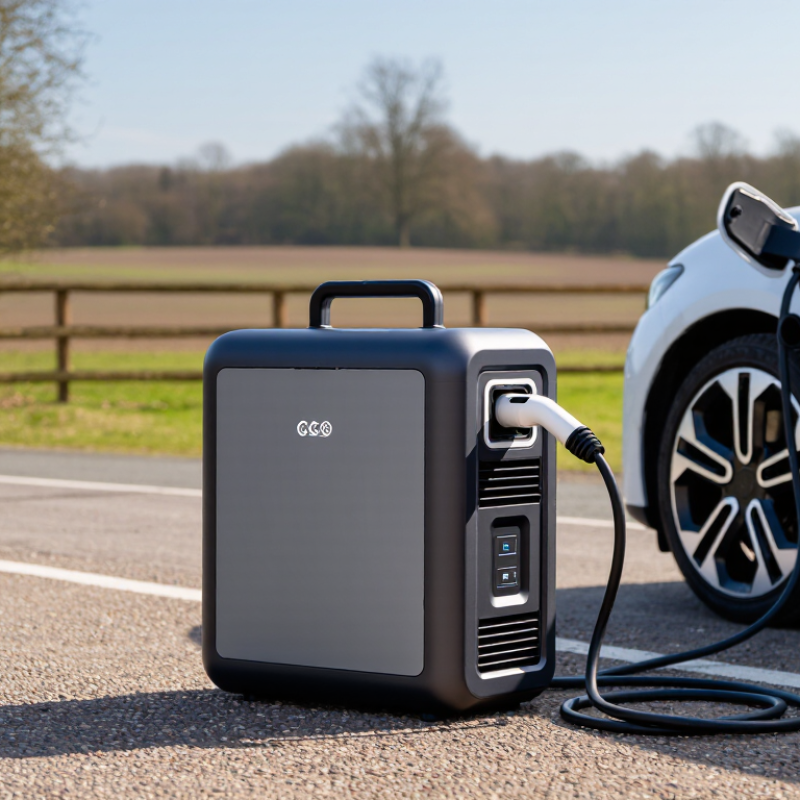
A portable EV charging station is equipment that supplies electricity to an electric vehicle away from a fixed charger. The term is used loosely. Some people mean a compact cable-based EVSE that plugs into a compatible outlet; others mean a wheeled battery unit. Those are different tools. An EVSE manages the connection and electrical safety, but does not necessarily store energy. A battery-powered unit does, though its usable capacity, output, and recharge time vary.
The International Energy Agency’s Global EV Outlook 2024 counted about 4 million public charging points worldwide in 2023. China held roughly two-thirds, or around 2.7 million. That growing network does not eliminate every charging gap. Portable equipment can help where parking is temporary or fixed chargers are scarce. Check connector type, voltage, current rating, weather protection, and the power supply’s capacity before use. Small details matter. “Portable” can also mean heavy, slow to recharge, or limited in output. It is not automatically a substitute for a high-power fixed charger.
A portable EV charging station is a transportable AC charging device (often called a portable EVSE) that connects an electric vehicle to a suitable power supply. It controls and protects the charging connection; it is not, by itself, a battery-powered charger.
| Option or factor | Typical specification or requirement in China | What it means in practice |
|---|---|---|
| Lower-power household supply | About 220 V × 10 A = 2.2 kW, where the outlet and circuit are rated for the load | Useful for occasional or overnight top-ups, but slow for a large battery. Do not assume an ordinary outlet is suitable for prolonged high-current charging. |
| Dedicated 16 A supply | Up to about 3.5 kW at 220 V | A common portable AC charging range. Use a properly rated outlet and circuit, and confirm the vehicle accepts the device’s current and connector. |
| Dedicated 32 A supply | Up to about 7 kW at 220 V, subject to the supply, EVSE, and vehicle | Can provide faster portable AC charging, but requires a suitably installed and protected 32 A circuit. It cannot make a vehicle’s onboard AC charger exceed its own limit. |
| Approximate charging time | For 36 kWh added to the battery: roughly 18 hours at 2.2 kW, 11 hours at 3.5 kW, or 5.5 hours at 7 kW | Illustrative estimates assume about 90% charging efficiency and that the EV can accept the full stated power. Actual time varies with the vehicle, temperature, charging losses, and power supply. |
| Connector compatibility | Check for the vehicle’s matching AC connector; GB/T 20234.2 is China’s standard for conductive AC charging connectors | Verify both the vehicle-side connector and the power-side plug. An adapter should not be treated as a substitute for electrical compatibility or a correctly rated supply. |
| Electrical protection | Look for documented overcurrent, overtemperature, leakage-current, and grounding protections appropriate to the device and installation | Protection features differ by model. Follow the instructions, use a properly grounded circuit, and have a qualified electrician assess a new or higher-current outlet. |
| Outdoor use and portability | Check the stated ingress-protection rating, operating conditions, cable length, and storage requirements | A portability claim does not guarantee that the device or power connection is safe in rain, standing water, or extreme temperatures. Follow the specific product instructions. |
| Best fit for most drivers | A portable AC EVSE whose connector matches the vehicle, whose current matches a verified supply, and whose protection and documentation are clearly specified | There is no single best choice for every driver. For regular home charging, a suitable dedicated circuit and fixed charging equipment may be more convenient; a portable unit is most useful when flexibility is needed. |
Note: Power and charging-time figures are approximate examples based on nominal 220 V AC. The actual allowable load and charging rate depend on the installation, EVSE, and vehicle.