Empowering Engineering Excellence: Innovate, Elevate, Deliver.
Choosing the best Hose Clamps in 2026 starts with the hose, not the clamp. Diameter, material, pressure, temperature, and vibration all affect how securely a connection holds. A clamp that works well on a garden hose may be unsuitable for a hot engine bay or a frequently serviced pump. Small details matter.
Worm-drive clamps are widely used because their bands tighten with a screw and can be adjusted with common tools. Spring clamps can maintain tension as some hoses expand and contract with temperature changes. T-bolt designs provide strong, even clamping for larger or demanding connections, while ear clamps offer a compact, low-profile fit when the correct size and installation tool are available. Each type has limits. There is no universal winner.
A reliable choice begins with the hose manufacturer’s recommendations and the clamp’s stated size range. Measure the outside diameter with the hose fitted over its connection, then check that the band sits squarely behind the fitting bead. Look for corrosion-resistant materials where moisture or chemicals are present, and inspect the assembly periodically for loosening, wear, or leaks. For critical systems, follow qualified technical guidance rather than relying on appearance alone. That choice is less tidy than it sounds. This guide compares the leading clamp types, their practical strengths, and the conditions where each makes sense. It also points out common selection mistakes, because a clamp can look secure while still being the wrong fit. No type replaces careful installation.
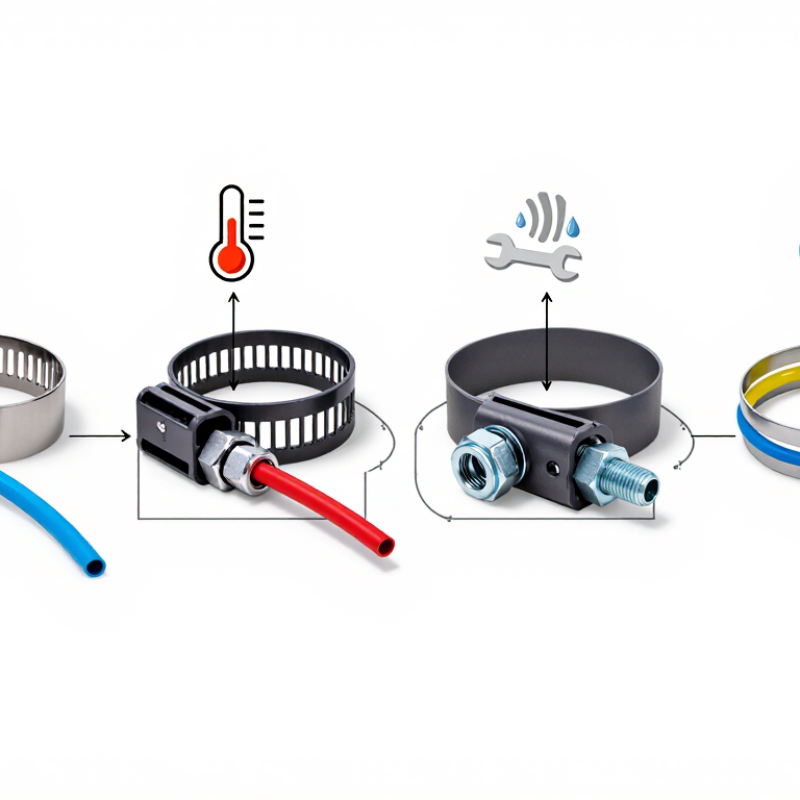
A hose clamp compresses a flexible hose around a fitting, helping limit leaks and prevent the hose from slipping off. The basic idea is simple: even pressure around the hose creates a tighter seal. The right clamp depends on hose material, outside diameter, fitting shape, and operating conditions. Common options include worm-drive, spring, and T-bolt clamps. Worm-drive clamps tighten with a screw and suit many general-purpose connections. Spring clamps maintain pressure as a hose expands or contracts with temperature. T-bolt clamps provide broad, strong clamping force for larger or higher-vibration connections.
No clamp fits every job.
Fit matters as much as clamp type. Choose a size that sits within the clamp’s adjustment range, then place it behind the fitting’s raised bead, not at the hose tip. Tighten it evenly until the hose is secure; overtightening can cut soft rubber or distort thin-walled fittings. Check the connection after operation, especially if heat or vibration is present. Look for dampness, bulging, or a shifted hose. A dry surface is reassuring, but not proof of a perfect seal.
One easy detail to overlook: old, hardened hose may leak even under a correctly fitted clamp. Sometimes the clamp is not the problem.
Hose clamp designs control pressure in different ways. A worm-drive clamp uses a slotted metal band and screw housing. Turning the screw tightens the band around a hose, making adjustments straightforward with a hand tool. The band can leave pressure uneven if overtightened, especially on a soft hose. Fit matters. Choose a size that closes securely without reaching the end of its adjustment range.
Spring clamps use shaped spring steel to maintain tension as a hose expands or contracts with temperature. Their handles can be squeezed open for installation, then released to grip the hose. They work well where temperatures fluctuate, but removal may require pliers and access around the clamp. Ear clamps instead use a small raised tab that is compressed with a suitable tool. The resulting connection is compact, though removal usually damages the clamp. Small details matter.
For larger hoses or connections exposed to vibration, T-bolt clamps use a bolt and bridge to apply strong, relatively even pressure around a wide band. They can be bulky and may be excessive for a small, flexible line. In practice, clamp choice depends on hose material, working pressure, temperature, and available space. Check the manufacturer’s installation guidance and inspect the connection after fitting. A clamp that feels tight is not automatically sealed correctly; that distinction is easy to overlook.
Clamp material should match the fluid, surroundings, and service temperature. In dry indoor settings, zinc-plated carbon steel offers an economical choice, but scratches and cut edges can rust. For general outdoor exposure or clean water, 304 stainless steel usually provides better corrosion resistance. Salt changes everything. Grade 316 contains molybdenum, which improves resistance to chloride-related pitting near coasts or on road-salt-exposed equipment. It is not immune to corrosion, especially in stagnant saltwater or under deposits.
The NACE International IMPACT study estimated corrosion costs at 2.5 trillion US dollars annually, about 3.4 percent of global GDP, using 2013 data. That estimate covers many industries, not hose clamps alone, but it shows why material selection matters. For strong vibration or higher tightening loads, a robust stainless band may be preferable; check that the screw and housing are corrosion-resistant too. A mixed-metal assembly can still develop corrosion at contact points. Check the cut edge. Match the clamp to the hose manufacturer’s pressure and temperature limits, then inspect it after installation. A material chart helps, but it cannot predict every splash, trapped deposit, or maintenance gap.
| Clamp Type | Typical Material Options | Best Suited Conditions | Key Advantages | Considerations |
|---|---|---|---|---|
| Worm-drive (band) clamp | 304 stainless steel; 316 stainless steel; zinc-plated carbon steel | General plumbing, automotive, irrigation, and equipment connections where the hose and fitting allow a band-style clamp | Adjustable over a range of diameters; widely available; easy to install with common tools | Use a smooth or rolled-edge band for softer hoses. Tightening too far can damage a hose or distort a fitting. |
| T-bolt clamp | Stainless steel band and bolt; some versions use plated steel hardware | Large-diameter or higher-pressure connections, such as charge-air, turbo, and industrial hoses, when specified by the equipment maker | Provides strong clamping force and a robust bolted closure | Requires correct sizing and tightening torque. It is not automatically suitable for every high-pressure application; follow hose and system specifications. |
| Spring-band clamp | Spring steel, often with a corrosion-resistant coating or stainless steel | Automotive and appliance hoses exposed to temperature changes and vibration, where a self-adjusting clamp is specified | Maintains clamping force as a hose expands or contracts with temperature | Must match the hose diameter and application. Installation may require dedicated pliers; inspect for corrosion or loss of spring force. |
| Constant-tension clamp | Spring stainless steel or other spring-grade steel, depending on design | Hose assemblies subject to repeated thermal cycling, such as engine-cooling systems, when compatible with the hose and fitting | Designed to help compensate for changes in hose diameter as temperatures vary | Performance depends on the clamp design and operating range. Choose by the application specification rather than appearance alone. |
| Wire clamp | Plated steel or stainless steel wire | Selected low- to moderate-pressure hose connections, including some suction or appliance applications | Compact and can provide effective circumferential retention on compatible hose profiles | Concentrated contact can mark or damage soft hose. Check that the wire style is approved for the hose and service pressure. |
| Ear (pinch) clamp | Stainless steel or coated steel | Production hose assemblies and compact connections where a permanent, correctly sized crimp-style closure is suitable | Low profile; once installed correctly, it resists loosening from ordinary vibration | Usually requires dedicated crimping tools and is not readily reusable. Correct sizing and installation are essential. |
| Plastic clamp | Nylon or other engineered polymer, depending on design | Light-duty, low-pressure applications where electrical isolation or resistance to certain chemicals is needed and the polymer is compatible | Non-metallic and lightweight; can be useful where metal contact is undesirable | Temperature, ultraviolet exposure, chemical compatibility, and load capacity vary by polymer. Do not assume it can replace a metal pressure clamp. |
| Clamp Material | Typical Corrosion Behavior | Suitable Conditions | Limitations and Selection Notes |
|---|---|---|---|
| 304 stainless steel | Good general corrosion resistance in many indoor and outdoor environments | General-purpose use, freshwater exposure, and many automotive or industrial settings | May pit or corrode in chloride-rich environments, including seawater and some coastal or chemical settings. |
| 316 stainless steel | Greater resistance to chloride-related corrosion than 304 stainless steel | Marine, coastal, washdown, and other chloride-exposed conditions when the full clamp assembly is appropriately specified | Not corrosion-proof in every chemical or high-temperature environment. Check compatibility with the specific fluid and cleaning chemicals. |
| Zinc-plated carbon steel | Protective zinc coating offers limited corrosion protection; scratches and wear can expose the underlying steel | Dry or mildly corrosive indoor applications where cost is a priority | Generally less suitable for persistent moisture, salt spray, or harsh outdoor exposure than stainless steel. |
| Coated or galvanized steel | Protection depends on coating type, thickness, and condition | Some general industrial or outdoor uses where the coating is suitable for the exposure | Coating damage can reduce corrosion resistance. Confirm that the clamp’s coating and hardware are appropriate for the environment. |
| Spring-grade steel | Varies; may be coated or stainless, depending on the clamp | Applications requiring elastic force, including many spring-band and constant-tension designs | Do not infer corrosion resistance from the spring function alone. Confirm the material and coating, especially in wet or salty conditions. |
| Engineered polymer | Does not rust; resistance to chemicals and weather varies by polymer | Light-duty applications where non-metallic construction is beneficial and service conditions are within the material rating | Can be limited by heat, ultraviolet exposure, creep, and mechanical load. Verify temperature and pressure ratings for the exact product. |
Selection note: Choose a clamp by hose outside diameter, fitting design, operating pressure, temperature range, vibration, and exposure to moisture, salts, or chemicals. Material and performance can vary between clamp designs; follow the hose and equipment manufacturer’s requirements and the clamp’s published specifications.
Start with the hose’s working pressure and outside diameter after installation. A clamp cannot increase a hose’s pressure rating. Check the hose and fitting specifications together, including any pressure changes caused by heat or pulsation. SAE J1508 sets performance requirements and test methods for several clamp designs. It is a useful reference, but it does not replace the equipment maker’s limits. Fit matters. A band that is too narrow or overtightened can cut soft rubber, while an undersized clamp may not seal.
Match the clamp to the hose material and temperature swings. Worm-drive clamps suit many serviceable connections; constant-tension spring clamps can accommodate some thermal expansion, and T-bolt styles are used in demanding applications when the assembly is rated for them. For compressed-air lines, the U.S. Department of Energy’s Improving Compressed Air System Performance guide reports that leaks can waste 20–30% of compressor output in typical industrial facilities. That figure covers system leaks, not clamps alone, but it shows why a small joint deserves attention. Check for manufacturer-specified torque, then inspect after the first heat cycle. I would still verify the fit on the actual hose: nominal sizes do not always tell the whole story.
In 2026, the best hose clamp depends on the hose material, fitting, and pressure changes. Worm-drive clamps work well on many serviceable connections, such as coolant hoses or household plumbing. Their screw mechanism allows adjustment with common tools. However, uneven tightening can pinch soft hose or leave a leak path. Check the hose maker’s guidance before installation.
Constant-tension spring clamps suit systems that heat and cool repeatedly, including some engine hoses. They maintain pressure as the hose expands and contracts. T-bolt clamps provide broad, strong clamping force for larger, reinforced hoses, such as those used in charge-air or industrial equipment. Ear clamps create a low-profile, permanent-style fit on compatible tubing, while wire clamps can suit molded hoses with narrow grooves. Fit matters. A high-force clamp is not automatically better; it can deform the hose.
Tips: Match clamp diameter to the hose’s outside diameter after fitting. Tighten evenly, then inspect for seepage after the system reaches operating temperature. One easy-to-miss detail is hose condition: a cracked or hardened hose may still leak, even with a new clamp.
Where each hose clamp type performs best, based on its design.
Relative design-fit scores range from 1 (less suited) to 5 (more suited). Worm-drive clamps are versatile for general service; T-bolt clamps are often selected for demanding, larger-hose connections; spring-band clamps accommodate hose expansion and contraction; and ear-style clamps suit compact, permanent assemblies. Scores are qualitative guidance, not standardized test results or pressure ratings. Actual performance depends on clamp material, dimensions, hose, and operating conditions.