Empowering Engineering Excellence: Innovate, Elevate, Deliver.
Choosing the right Police Drone Detector requires more than comparing detection ranges or product prices. Police departments, airport teams, and critical infrastructure operators face different airspace conditions. Urban buildings can block radio signals. Open fields may expose radar reflections. A reliable buying decision starts with the operating environment, not a sales brochure.
This guide examines major detector types for global buyers, including radio-frequency sensors, radar systems, protocol-based analyzers, acoustic arrays, and camera-assisted solutions. Each type offers practical strengths. RF sensors can identify common communication links. Radar can support detection when radio signals are limited. Acoustic systems may help in quieter locations, while cameras provide visual confirmation. No single device performs perfectly in every setting.
Real-world evaluation matters. A detector should be tested near concrete walls, moving vehicles, trees, and crowded wireless networks. False alerts can waste staff time. Missed alerts can create serious operational gaps. Buyers should review detection evidence, data protection practices, training requirements, maintenance support, and regional certifications. Integration with approved command platforms may also improve response coordination.
The best choice is rarely the most expensive model. It is the system that delivers understandable alerts, dependable records, and manageable ownership costs. Specifications can look impressive. Field performance may differ. This guide offers a practical framework for comparing Police Drone Detector technologies while recognizing an important limitation: market claims are not a substitute for supervised testing and professional assessment.
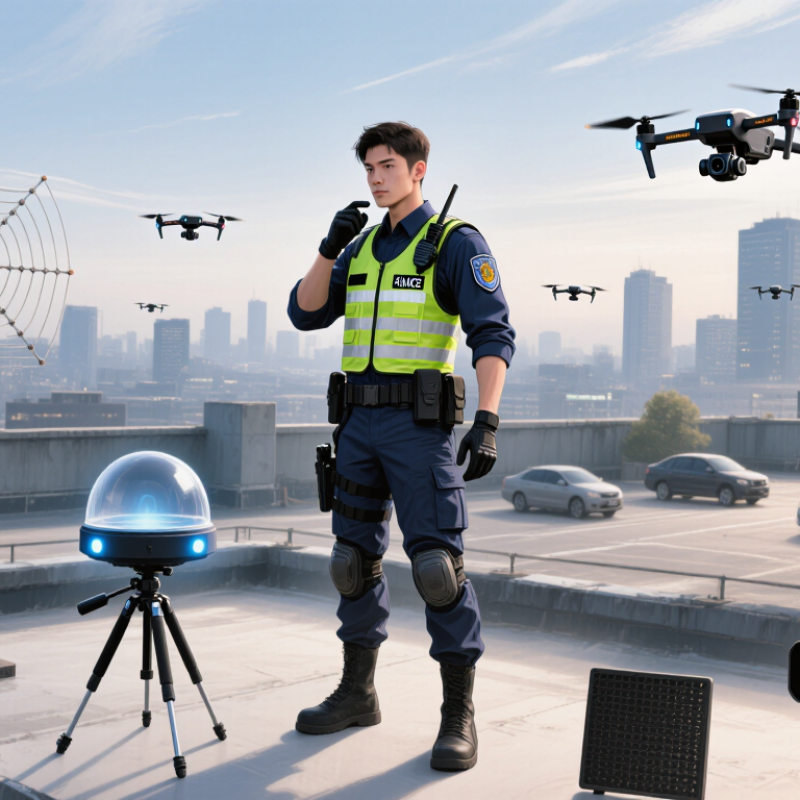
Police drone detectors help officers understand nearby unmanned aircraft activity without relying on visual sight alone. These systems usually combine radio-frequency sensing, radar, acoustic analysis, and optical observation. Each method answers a different question. Radio-frequency sensors may identify communication signals and estimate direction. Radar can track movement, distance, and altitude. Acoustic sensors listen for rotor patterns, while cameras support visual confirmation.
The best choice depends on the site, weather, staffing, and response policy. A city center may need wide-area monitoring with strong interference filtering. A small public venue may prefer a portable unit with a simple display. Field teams should record detection time, location, confidence level, and operator action. This creates a useful evidence trail. It also exposes weaknesses.
False alerts still happen. Buildings, power equipment, and ordinary wireless devices can confuse a sensor. Some aircraft may remain difficult to identify, especially when signals are weak or absent. For that reason, trained personnel should verify alerts through multiple sources before taking any action. Detection is not the same as identification. It is also not proof of harmful intent.
Modern law enforcement uses these tools mainly for situational awareness, public safety, and controlled airspace protection. Deployment should follow applicable aviation, privacy, data-handling, and communications rules. Clear access controls matter. So does regular calibration. A detector can display impressive data and still support poor decisions if staff lack practice. Short drills, documented procedures, and independent review improve reliability, although no system removes uncertainty completely.
| Detector Type | Primary Detection Target | Operating Principle | Typical Practical Range | Main Strengths | Important Limitations | Common Law Enforcement Applications | Best Deployment Role |
|---|---|---|---|---|---|---|---|
| Radio-Frequency (RF) Detector | Radio links between a drone, remote controller, and sometimes a ground station | Passively monitors known or configurable frequency bands and identifies signal patterns associated with command, telemetry, or video transmission | Approximately 1–5 km in open conditions; shorter in dense urban areas or where signals are shielded | Passive operation, rapid alerts, low risk of interfering with communications, and useful for identifying active control links | May not detect autonomous drones, drones using uncommon frequencies, or aircraft operating with very low-power or encrypted transmissions | Perimeter protection, prisons, public events, airports, government facilities, and temporary security operations | Primary early-warning layer for detecting active wireless control activity |
| Protocol-Aware RF Detector | Compatible drone control, telemetry, and identification protocols | Analyzes wireless signal characteristics and protocol behavior to classify likely drone and controller activity | Typically about 1–3 km for reliable classification, depending on antenna height, signal strength, and local interference | Can provide more useful classification than a basic energy detector and may help distinguish drone signals from ordinary Wi-Fi activity | Performance depends on the supported protocol library; new, modified, or proprietary systems may be missed | Evidence-supported detection, protected-site monitoring, and operational screening in areas with heavy radio traffic | Identification and classification layer within a multi-sensor system |
| Spectrum Analyzer | Unusual or changing radio-frequency activity across selected bands | Displays and records signal power, frequency occupancy, bandwidth, and signal behavior for expert analysis | Dependent on antenna and signal strength; often suitable for local-area investigation rather than long-range automatic detection | Broadband visibility, flexible investigation, interference analysis, and support for forensic or technical teams | Usually requires trained operators and may not automatically determine whether a signal is produced by a drone | Incident investigation, site surveys, interference troubleshooting, and support for counter-drone teams | Technical analysis and verification tool rather than a standalone alarm system |
| RF Direction-Finding System | Direction and approximate location of an active drone controller or radio transmitter | Uses multiple antennas, antenna arrays, or multiple synchronized sensors to estimate the bearing of a detected signal | Generally effective over several kilometers when a clear signal and suitable antenna elevation are available | Can support bearing lines, source localization, and coordinated response; passive systems do not transmit toward the target | Accuracy can decrease because of reflections, buildings, terrain, multipath effects, and weak or intermittent signals | Locating pilots near prisons, stadiums, borders, restricted facilities, and major public gatherings | Detection-plus-localization layer for response teams and investigation units |
| Short-Range Radar | The physical movement of drones and other airborne objects | Transmits radio energy and analyzes reflected signals to estimate range, direction, speed, and track behavior | Roughly 0.5–5 km for many small-drone security applications; performance varies substantially with radar design, terrain, weather, and target size | Can detect radio-silent or autonomous drones and provide continuous track information in day or night conditions | Birds, buildings, vegetation, weather, and other objects may create false alarms; classification often needs another sensor | Airport approaches, critical infrastructure, military or government sites, and wide-area perimeter surveillance | Primary detection and tracking sensor for non-cooperative or autonomous targets |
| Electro-Optical and Infrared (EO/IR) Camera | Visible or thermal appearance of a drone and its surroundings | Uses daylight cameras, thermal imaging, or both to visually confirm and track a detected object | Detection and identification depend on optics, weather, lighting, target size, and line of sight; practical identification is normally shorter than radar detection range | Provides visual confirmation, evidence recording, target identification, and operator assessment | Fog, rain, darkness, glare, camouflage, and obstructions can reduce performance; cameras alone may not detect a small distant drone reliably | Evidence collection, visual verification, incident recording, and cueing from radar or RF sensors | Confirmation and classification layer in a sensor-fusion system |
| Acoustic Drone Detector | Distinctive sound patterns from drone motors and propellers | Microphone arrays compare acoustic signatures and estimate the presence or direction of nearby aircraft | Commonly hundreds of meters in relatively quiet conditions; considerably less in heavy traffic, wind, or industrial environments | Passive, compact, low power, and useful where radio emissions are absent or difficult to analyze | Background noise, wind, echoes, vegetation, and multiple sound sources can reduce accuracy; limited suitability for long-range detection | Quiet campuses, prisons, construction sites, event venues, and local perimeter monitoring | Short-range supplementary sensor, especially for radio-silent drones |
| Remote Identification Receiver | Broadcast identification and status information transmitted by compliant drones | Receives standardized broadcast data such as aircraft identification, location, altitude, and sometimes controller or takeoff location information | Often from several hundred meters to several kilometers, depending on broadcast power, receiver position, antenna, and local regulations | Can provide useful identity and location data without active radar transmission and may support faster legal and operational decisions | Only works when the aircraft is broadcasting a compatible signal; data may be absent, inaccurate, altered, or unavailable under local rules | Event security, airspace compliance monitoring, evidence preservation, and authorized drone-traffic management | Identification and situational-awareness layer, not a complete detection solution |
| GNSS Interference and Navigation-Anomaly Monitor | Possible satellite-navigation interference, spoofing, or abnormal positioning behavior | Measures satellite-navigation signal quality, timing consistency, and interference indicators in the local area | Highly dependent on transmitter power, antenna placement, terrain, and interference conditions; it does not provide a reliable drone range by itself | Helps identify navigation-related risks and supports investigation of unusual drone behavior | Cannot normally confirm that a drone is present or identify the specific aircraft causing the anomaly; interference monitoring may be legally regulated | Critical infrastructure protection, airspace investigations, and security monitoring near sensitive sites | Specialized supporting sensor for navigation-risk assessment |
Buyer’s Note: Practical range, classification accuracy, and false-alarm performance vary with terrain, buildings, weather, antenna height, radio congestion, target size, and local regulations. For modern law enforcement, a layered system combining RF, radar, visual confirmation, remote identification, and trained operators is generally more reliable than relying on one detector type alone.