2026 Top EV E Axle Suppliers in China for Global Buyers?
China has become a major source of electric drive systems for international vehicle manufacturers. This guide examines the 2026 market for an EV e-axle supplier China, focusing on engineering capability, production scale, and export reliability.
An e-axle combines the motor, inverter, reduction gear, and differential in one compact unit. That integration can reduce weight, wiring, and assembly time. However, impressive specifications do not guarantee dependable field performance. Buyers should inspect continuous torque, peak efficiency, thermal control, sealing, noise, vibration, and endurance-test records. A polished brochure is not enough.
Professor Guo Konghui, a respected Chinese automotive engineer, has emphasized a practical principle: “The whole vehicle system must work together.” This view matters when comparing suppliers. An e-axle may perform well on a test bench, yet struggle after installation because of calibration, cooling, software, or suspension differences. Small details matter. Connector protection. Gear oil control. Service access.
This overview will compare leading Chinese suppliers through an international buyer’s perspective. It considers prototype support, customized mounting points, voltage compatibility, certification preparation, delivery consistency, and after-sales response. Some companies offer excellent motors but limited overseas support. Others provide strong documentation but less flexible engineering. That trade-off deserves attention.
The ranking should not be treated as permanent. New factories appear, partnerships change, and real-world vehicle data can revise early impressions. Buyers should still conduct independent audits, sample testing, and commercial due diligence before signing contracts. That caution is not pessimism. It is basic engineering discipline.
What Is an EV E-Axle and How Does It Work?
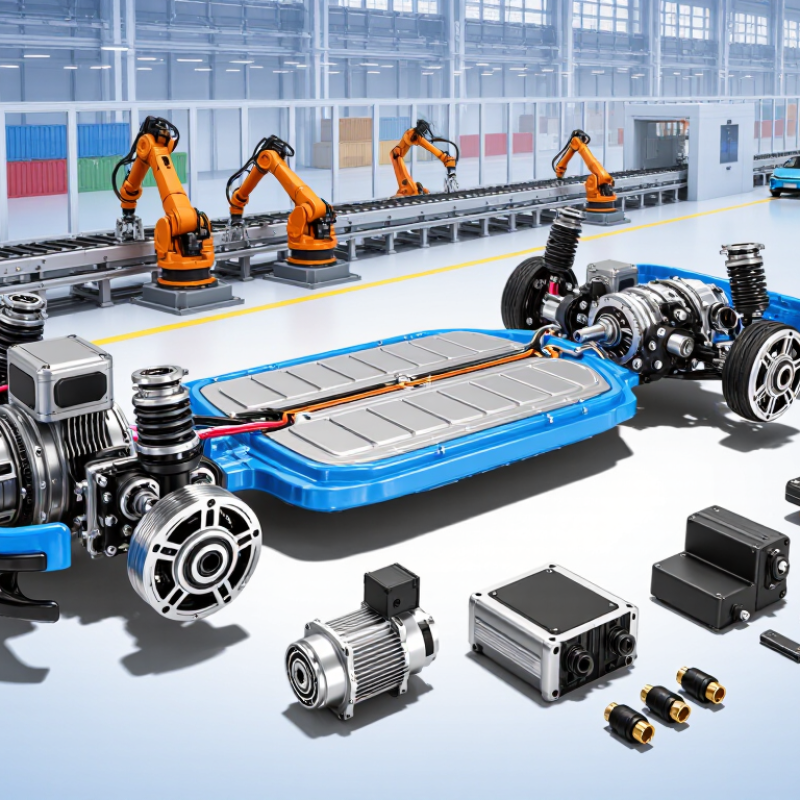
An EV e-axle is a compact electric drive unit mounted across an axle. It usually combines an electric motor, inverter, reduction gears, and differential. This layout replaces several separate drivetrain components. It also frees space around the vehicle floor.
The working process is direct. The battery sends direct current to the inverter. The inverter changes it into controlled alternating current. That current creates a rotating magnetic field inside the motor. Gears then increase wheel torque, while the differential manages different wheel speeds during cornering. During braking, the motor can work as a generator. It sends part of the kinetic energy back to the battery. The sensation is often smooth, but calibration still matters.
The International Energy Agency reported nearly 14 million electric cars sold globally in 2023. Electric vehicles represented about 18% of new car sales. This growth increases demand for efficient, compact axle systems. The U.S. Department of Energy notes that modern electric-drive systems can achieve very high conversion efficiency, often above 90% under suitable conditions. Real vehicles perform less consistently. Tire losses, heat, traffic, and software settings change the result.
For global buyers, evaluation should include continuous power, peak torque, voltage range, cooling performance, noise, vibration, and durability testing. A lighter e-axle is not automatically better. Thin housings may reduce mass but increase vibration risks. Suppliers should provide test methods, thermal maps, service data, and traceable production records. The details are easy to overlook. That can become expensive.
China’s Top EV E-Axle Suppliers for Global Buyers in 2026
China’s leading EV e-axle suppliers for global buyers in 2026 should offer more than attractive pricing. They need proven integration experience across passenger cars, light commercial vehicles, and selected off-highway platforms. A capable supplier can explain motor output, reduction ratios, inverter matching, thermal limits, and software communication without hiding behind vague claims. Details matter.
Global buyers should examine complete test evidence before approving samples. Useful records include efficiency maps, peak torque duration, NVH measurements, EMC results, waterproofing tests, and endurance cycles. Ask whether the data came from production-intent units or laboratory prototypes. A polished brochure is not proof. That gap matters. Suppliers should also demonstrate compliance planning for the target market, including functional safety, cybersecurity, environmental requirements, and traceable quality controls.
Factory visits can reveal practical differences. Check winding lines, gear inspection equipment, rotor balancing, end-of-line testing, and spare-parts storage. Review how suppliers handle software updates and field failures. Response time matters during vehicle validation. A strong partner provides clear drawings, change-control records, calibration support, and realistic delivery schedules. However, even experienced suppliers may underestimate regional service needs or winter testing. Buyers should reserve time for independent validation, pilot production, and corrective actions before large-volume contracts. A lower quotation may become expensive when integration work is poorly defined.
China’s new energy vehicle market expanded from approximately 1.37 million sales in 2020 to 12.87 million in 2024. This sustained growth supports increasing global demand for integrated electric drive systems, including e-axles, electric motors, inverters, and reduction gear assemblies. Figures are based on China Association of Automobile Manufacturers annual NEV production and sales statistics.
Key E-Axle Technologies and Product Categories in China
China’s e-axle industry is moving from simple motor integration toward complete electric drive platforms. The IEA’s Global EV Outlook 2025 reports that global electric car sales exceeded 17 million units in 2024. China accounted for more than 11 million sales, creating strong demand for scalable drivetrain systems.
Key product categories include 2-in-1, 3-in-1, and multi-in-1 e-axles. A 2-in-1 unit usually combines the motor and reducer. A 3-in-1 design adds the inverter, reducing wiring and installation space. Higher integration may include the onboard charger, DC-DC converter, and vehicle control functions. These systems suit passenger cars, light commercial vehicles, electric buses, and selected heavy-duty platforms.
Technology choices matter more than impressive specifications. Silicon-carbide inverters can reduce switching losses at higher voltage levels, especially in 800-volt systems. Oil-cooled motors support repeated acceleration and heavy loads. Hairpin windings improve copper utilization, but manufacturing quality must remain consistent. Some suppliers also offer dual-motor e-axles for all-wheel drive and modular units for different wheelbases.
Global buyers should examine efficiency maps, thermal test records, noise data, and software compatibility. Certification support is equally important. The China Electric Vehicle Charging Infrastructure Promotion Alliance recorded rapid charging-network growth in 2024, but real-world charging conditions still vary by region. That affects range claims. It is not a magic box. A compact e-axle may reduce assembly work, yet replacement costs and service training can become difficult. The best evaluation combines bench data, road testing, and honest lifecycle calculations.